
Read Report Here
The post UFCW Celebrates AANHPI Heritage Month appeared first on The United Food & Commercial Workers International Union.
]]>In May, our nation celebrates Asian American, Native Hawaiian, and Pacific Islander (AANHPI) Heritage Month. The AANHPI community has played an essential role in American culture, diversity, and the economy. At UFCW, we recognize the critical role members of the AANHPI community have played as active leaders in labor movements, calling for improvements to labor conditions, and an increase in wages and worker benefits. As a result of these heroic community members, substantial change has been made.
The origins of this celebration date back to 1977, when Representative Frank Horton of New York and Senator Daniel Inouye of Hawaii introduced resolutions to proclaim a week in May as Pacific/Asian American Heritage Week. When neither of these resolutions passed, Representative Horton introduced a similar resolution in 1978, which was passed by the House and Senate and signed into law by President Jimmy Carter that same year. In 1992, Congress designated the month of May as Asian/Pacific American Heritage Month to commemorate the arrival of the first Japanese immigrants to the U.S. on May 7, 1843, and the completion of the transcontinental railroad on May 10, 1869.
Here are three things to know about the work done by AANHPI community members—past and present— to fight for justice for workers and union members nationwide.
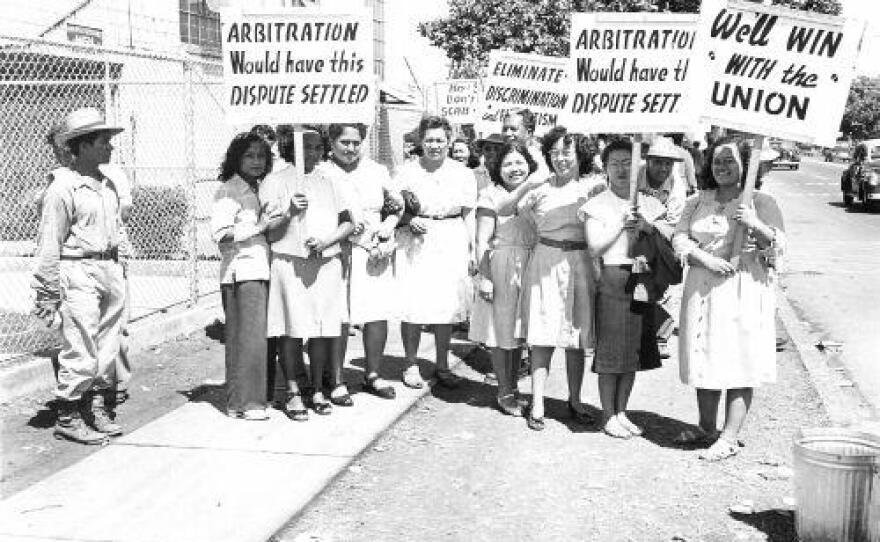
On August 31, 1946, over 26,000 sugar workers refused to report to their jobs, shutting down all but one of the 34 sugar plantations across the Hawaiian islands—one of the most expensive strikes in history.
The International Longshore and Warehouse Union (ILWU) organized the strike as a protest against poor working conditions, lack of benefits, and employee mistreatment, fueled by an economy that colonial powers had historically controlled.
By 1946, one-fifth of Hawaii’s population, roughly 100,000 people, lived and worked on sugar plantations. With a diverse population of employees, including Chinese, Japanese, Korean, and Filipino workers, the ILWU made inclusivity a key part of their campaign, ensuring representative leadership in the strike committee and conducting multilingual meetings.
The organization of a diverse movement proved to be a success. After 79 days of striking, the ILWU secured housing, medical, pensions, and wage benefits for workers.
Today, Hawaii’s workforce represents the second-highest union density in the nation with 21.9 percent of employees being represented by a union. Ultimately, the 1946 Sugar Strike transformed the social and economic climate of Hawaii and improved working conditions across the region.
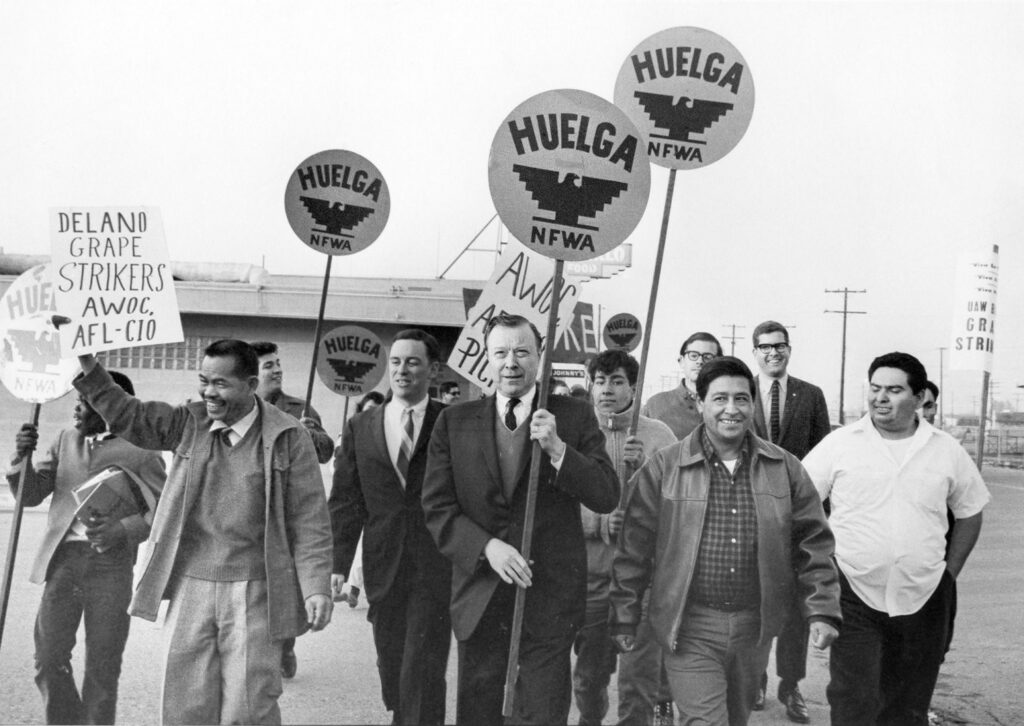
On September 8, 1965, 2,000 Filipino American farm workers refused to report to their jobs picking grapes in the valley north of Bakersfield, California. This movement was organized by Larry Itliong of the Agricultural Workers Organizing Committee (AWOC), a predominantly Filipino union. Itliong and workers had one main goal – better working conditions for grape farmers.
About two weeks later, the National Farm Workers Association (NFWA), a group of Mexican American farmworkers led by Cesar Chavez and Dolores Huerta, joined the AWOC strike. Together, AWOC and NFWA formed what would be known as the United Farm Workers (UFW).
The UFW was determined to win—and after five years of striking and an international grape boycott, the Delano Grape strikers prevailed. New contracts were signed in 1970.
In the wake of the Delano Grape Strike’s success, Itliong formed a legacy of activism within his community. He resigned from the UFW in 1971 under the belief that the union lacked support for aging Filipino American farm workers. He was an elected delegate at the 1972 Democratic National Convention and oversaw the development of housing for retired Filipino farm workers. His initial involvement in the Delano Grape Strike and lifelong activism represents the role of Filipino Americans within the farm labor movement—the stories that have often gone untold.
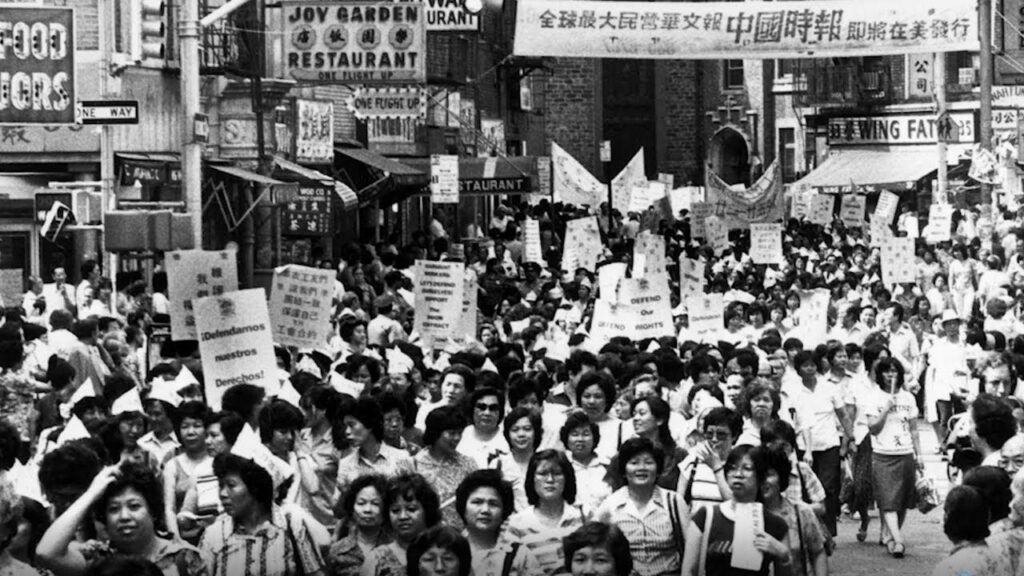
On June 24, 1982, over 20,000 garment workers gathered in Columbus Park in New York City’s Chinatown. These workers—predominantly Chinese American women—rallied to demand better working conditions and livable wages.
The strike was organized by the International Ladies Garment Workers Union and was set in motion after contractors refused to renew union contracts that asked workers to give up already scarce benefits.
Holding signs that said, “Union workers: Let’s defend ourselves. Support the union contract,” “In union, there is strength,” and “Defend our rights,” tens of thousands of workers marched through the streets of Chinatown, demonstrating the power they held over the city’s economy and garment industry. The sight of togetherness and strength led contractors to fold. Only a few days after the strike began, contractors agreed to sign the union contracts.
The 1982 Chinatown Garment Strike was a historic victory, providing higher wages and benefits for tens of thousands of workers in the city and amplifying Asian American voices. Garment workers transformed the economic conditions of an industry that historically exploited them, changing the future of the labor movement.

The Asian Pacific American Labor Alliance, APALA, AFL-CIO, was founded in 1992 allowing API workers, union members, and allies to make strides in advancing immigrant, labor, and civil rights. APALA is a strong representation of efforts in modern AAPI labor movements with 22 chapters and pre-chapters and a national office in Washington D.C. More information can be found here: APALA – Home (apalanet.org)
The post UFCW Celebrates AANHPI Heritage Month appeared first on The United Food & Commercial Workers International Union.
]]>The post From Albertsons & Smiths to Allegiant Stadium appeared first on The United Food & Commercial Workers International Union.
]]>Every year, the NFL Players Association gives UFCW two Super Bowl tickets that we raffle off to our members as a token of our appreciation. In early February, Thomas (Tom) Strysniewicz, UFCW Local 711 worker, was informed that he was the winner. So this past Sunday, while the rest of us were watching the Kansas City Chiefs face off against the San Francisco 49ers from the comfort of a couch, Tom was watching the big game play out live from Allegiant Stadium at Super Bowl LVIII!

After the Chiefs defeated the 49ers in an overtime thriller and the confetti settled, we were able to catch up with Tom and are excited to share our interview about his experience, along with some photos with you all below.
UFCW: Tell us about yourself. Where do you work, and how long have you been a union member?
Tom: I started in the grocery industry back in 2015 here in Las Vegas, NV at Albertsons, where I was trained as a produce clerk. After a few years at Albertsons, I transferred over to Smiths store #346, where I currently reside. I am still in produce and tend the wet rack daily.
UFCW: How did you feel when you found out you were selected to attend the Super Bowl?
Tom: When I received a phone call two weeks ago from my local union office saying I was the winner, I was stunned. Deanne, from my Local informed me my name was chosen out of a hat to be the one to win two tickets to Super Bowl LVIII.
Shocked and in disbelief were probably the two feelings that ran through my mind during that call – immediately followed by insane screaming and jumping for joy!
UFCW: Who did you bring with you?
Tom: I ended up bringing my older brother John with me. He has been a member of our local union for the past 25 years and works in my store in the bakery. He was ecstatic when he found out I had won, and he was coming along with me to experience the game!
UFCW: How was your experience at the Super Bowl? Any surprises or highlights during the game?
Tom: Gameday was everything we could have hoped for and then some! We arrived supporting the San Francisco 49ers and started indulging in all the game day festivities. Lots of drinking, eating, and socializing with other game attendees followed. This was both my brothers and I’s first NFL game, so for it to be the Super Bowl on top of that made it that much more special! We were seated in the 49ers end zone along with a sea of San Francisco fans; we were right at home! The game was insane to say the least! We got to see many celebrities and athletes roaming around the stadium. The game even had a fan streak through the field during gameplay, which we all found hilarious!
The game was a nail-biter down to the last second in overtime. Even though the team we were rooting for lost, it was still a spectacular game that my brother and I won’t ever forget! We are both beyond grateful to have gotten the opportunity to experience such a spectacle!
UFCW: What was your favorite part of the halftime show?
Tom: The halftime performance with Usher was fantastic! Everything you would expect from a performance put on by a superstar and had all the glitz of a Las Vegas show in a 13-minute performance. He had us all on our feet, bobbing our heads to the music, and enjoying the atmosphere.
UFCW: Besides winning the Super Bowl tickets, what do you consider to be the most rewarding aspects of being a member of our union?
Tom: This wouldn’t have been possible had it not been for UFCW and the way it supports its members. That is what I would consider the most rewarding aspect of being in the union – having the support and backing of the UFCW and knowing that they are fighting daily on my behalf so that I can have a better chance at a great working environment and a better future for my family and I.


The post From Albertsons & Smiths to Allegiant Stadium appeared first on The United Food & Commercial Workers International Union.
]]>The post Help Support Equal Pay Day on Nov. 30 appeared first on The United Food & Commercial Workers International Union.
]]>Help us draw attention to pay disparities on Native Women’s Equal Pay Day, which will take place on Thursday, Nov. 30. This is the day when Native American women’s pay finally catches up to what white men were paid last year.
Native American women working full-time, year-round are paid 59 cents and all earners (including part-time and seasonal) are paid 55 cents for every dollar paid to non-Hispanic white men. Women in indigenous communities are more likely to experience poverty, high levels of unemployment and other challenges in their lives.
Help us raise awareness about the inequality of pay for women on Nov. 30. You can get additional information about Native Women’s Equal Pay Day here.
The post Help Support Equal Pay Day on Nov. 30 appeared first on The United Food & Commercial Workers International Union.
]]>The post UFCW Celebrates Pride Month appeared first on The United Food & Commercial Workers International Union.
]]>The month of June is Pride Month, a time to celebrate the accomplishments of LGBTQ+ individuals in our union family. Pride Month is also an opportunity to reach out to LGBTQ+ workers seeking union representation, and commit to the ongoing pursuit of equal justice and true equity for the LGBTQ+ community.
UFCW OUTreach has many resources available free on their website and by request to help locals celebrate Pride Month, including a new 2023 Union Pride sticker in English, Spanish and French; pronoun pins and stickers; and educational pamphlets in English, Spanish and French.
Many UFCW locals across the U.S. and Canada already participate in Pride Month events, which are another way to show workers who want to organize that the UFCW is LGBTQ+ inclusive. The UFCW OUTreach Pride Guide is available to help locals show their support for all of our LGBTQ+ members during Pride Month and you can get more information here. UFCW OUTreach is also hosting a training session with the UFCW Women’s Network on May 31 and June 6, titled “Bystander Intervention + Conflict De-escalation.” You can find more information about the training session here.
“We urge all local unions to speak out against the anti-LGBTQ+ legislation and hate messages happening across our countries,” said UFCW OUTreach Chair Michele Kessler. “Let’s be loud and proud in our support for our LGBTQ+ members and their families. Our work places must be inclusive and safe for all.”
You can learn more about UFCW OUTreach here. If your local is interested in sharing photos of events or highlighting a member during Pride Month, please submit that information to Julie Anderson at janderson@ufcw.org.
The post UFCW Celebrates Pride Month appeared first on The United Food & Commercial Workers International Union.
]]>The post OUTreach Offers Creating Change Conference Scholarships appeared first on The United Food & Commercial Workers International Union.
]]>UFCW OUTreach is offering five full-paid scholarships for rank and file UFCW members to attend next year’s Creating Change Conference in San Francisco. The conference, which will take place on Feb. 17 to 21, 2023, is organized by the national LGBTQ Task Force.
This is the sixth year that UFCW OUTreach has provided scholarships to the Creating Change Conference, which is the foremost political, leadership, and skills-building conference for the LGBTQ+ social justice movement. Scholarship recipients will learn about a broad range of social justice issues and develop skills to bring back to their workplaces and local unions. Past session topics have included labor, gender equality, community organizing, criminal justice, immigration and more.
UFCW OUTreach Executive Board members attending the conference each year have served as a key voice for issues impacting hard-working families and the labor movement. Providing scholarships to UFCW members helps our union family to strengthen new member recruitment and develop new leaders within our union and in the broader LGBTQ+ movement.
The submission deadline for the five scholarships is Monday, Nov. 28. You can get more information about UFCW OUTreach scholarships to this important conference here.
If you have any questions or want to learn more about UFCW OUTreach, contact Michele Kessler at MKessler@ufcw1776.org.
The post OUTreach Offers Creating Change Conference Scholarships appeared first on The United Food & Commercial Workers International Union.
]]>The post UFCW Celebrates Hispanic Heritage Month appeared first on The United Food & Commercial Workers International Union.
]]>Thursday, Sept. 15 marks the beginning of Hispanic Heritage Month—a time for the UFCW to pay tribute to Hispanic Americans and their positive contributions to our union, communities and country. This year’s theme for Hispanic Heritage Month is “Unidos: Inclusivity for a Stronger Nation.”
The origins of this celebration date back to President Lyndon Johnson, who first established Hispanic Heritage Week in 1968. In 1988, President Ronald Reagan expanded the celebration to cover a 30-day period from September 15 to October 15. Hispanic Heritage Month was enacted into law in 1988, and the start date of September 15 was chosen for the celebration because it marks the anniversary of independence for a number of Latin American countries.
Observing Hispanic Heritage Month allows us to recognize and support the work Hispanic Americans are doing in helping this country and our union grow. Throughout Hispanic Heritage Month, the UFCW will pay tribute to the culture and history of Hispanic Americans and their positive impact on the labor movement and promote voter turnout leading up to the midterm elections. If you have members who would like to share their stories about what this month means to them, please reach out to Julie Anderson at janderson@ufcw.org.
###
The post UFCW Celebrates Hispanic Heritage Month appeared first on The United Food & Commercial Workers International Union.
]]>The post Black Women’s Equal Pay Day Is Sept. 21 appeared first on The United Food & Commercial Workers International Union.
]]>For more than a quarter-century, the United States has recognized Equal Pay Day: the day that marks how far into the new year the average woman must work to match what her male counterparts made the year before. This year, that day arrived earlier than it had in its 26-year history (March 15, 2022). While this progress is something that most certainly should be celebrated, full-time Black women workers have unfortunately continued to lose pay compared to their white male counterparts.
In 2020, Black women made 63 cents for every dollar paid to White, non-Hispanic men compared to 58 cents for every $1 paid to white men in 2022. For this reason, Black Women’s Equal Pay Day this year will be recognized on Sept. 21 over a month later than in 2021 (August 3rd). Black women are often victims of job segregation based on both gender and race.
The UFCW is committed to ensuring that Black women have the support they need to overcome the barriers they face at the intersection of sexism and racism. Equal pay for hard-working Black women across the country is long overdue and this month, we encourage members to make their voices heard to draw attention to the growing wage disparity. We should not be satisfied until equal pay days are no longer necessary at all.
You can get more information about Black Women’s Equal Pay Day here.
###
The post Black Women’s Equal Pay Day Is Sept. 21 appeared first on The United Food & Commercial Workers International Union.
]]>The post UFCW Celebrates Pride Month appeared first on The United Food & Commercial Workers International Union.
]]>The month of June is Pride Month, a time to commemorate the ongoing pursuit of equal justice for the LGBTQ+ community and celebrate its accomplishments in our union family.
The majority of Pride Month events are held in June to commemorate the anniversary of the Stonewall Inn uprising in New York City on June 28, 1969. At the time, police raids on bars catering to LGBTQ+ patrons were common. However, that night, the patrons of the Stonewall Inn fought back, marking the beginning of a movement to outlaw discriminatory laws and practices against LGBTQ+ Americans.
Even though the progress that many activists and leaders have made in spite of considerable obstacles throughout the years, our country continues to face inequities as discriminatory policies threaten the human rights of the LGBTQ+ community. During these challenging times, it’s more evident than ever that union contracts can provide stable protection for members of the LGBTQ+ community as they put decision-making power into the hands of workers.
As the labor movement is rooted in the principles of inclusion and equality, UFCW reaffirms its resolve to keep fighting for dignity and justice for every worker.
UFCW OUTreach is providing resources to help members and locals to become more inclusive for LGBTQ+ members and all workers, including free workplace flyers and pronoun stickers.
The post UFCW Celebrates Pride Month appeared first on The United Food & Commercial Workers International Union.
]]>The post Today is International Transgender Day of Visibility appeared first on The United Food & Commercial Workers International Union.
]]>March 31 is International Transgender Day of Visibility, a day dedicated to honor the accomplishments and contributions of the transgender individuals and community. As anti-LGBTQ+ measures across the country continue to pose a threat to transgender people, today also serves as a reminder that a lot still needs to be done to end discrimination and to gain full equality.
A union contract is one way to help protect the rights of transgender workers. A union contract puts the decision-making power into the hands of workers and can include strong language that explicitly protects individuals against discrimination on the basis of sexual orientation, gender identity, and expression.
UFCW OUTreach is a constituency group dedicated to advocating for full equality of LGBTQ+ workers in their jobs and unions, and to build a labor movement that embraces diversity, encourages openness, and ensures safety and dignity.

In 2020, UFCW OUTreach and the UCLA Labor Center conducted a study that highlights LGBTQ+ workers’ contributions to the labor movement and how they and their allies have benefited from union advocacy.
Read Report Here
The post Today is International Transgender Day of Visibility appeared first on The United Food & Commercial Workers International Union.
]]>The post How to prepare and protect yourself for flu season during the COVID-19 pandemic appeared first on The United Food & Commercial Workers International Union.
]]>After a very mild flu season last year, health experts warn that they are anticipating a huge spike in flu cases in the coming months. Last year’s drop was likely due to the widespread implementation of COVID-19 prevention efforts like wearing face masks, social distancing, reduced travel, as well as school, office, and public space closures.
With the country returning to in-person school and work and some of the prevention efforts being rolled back it’s especially important understand how you can stay safe against both COVID-19 and flu infections. We received numerous member questions on how to prepare for this flu season want to provide the most accurate information for our membership.
Symptoms for COVID and the flu are very similar with both potentially causing fever, fatigue, cough, shortness of breath and occasionally, gastrointestinal problems. Individuals can also be asymptomatic or experience mild to severe symptoms. One unique identifier of COVID-19 infection is many people reporting a change in or loss of taste or smell. COVID-19 symptoms can also appear much longer after exposure (two to 14 days), whereas flu symptoms usually appear within one to four days.
Due to the similarities, the best way to determine if you have the flu or COVID-19 is to get tested.
Although the flu should always be taken seriously, COVID-19 appears to be more contagious and more severe with nearly 45 million people infected since early 2020 in the U.S. and nearly 718,000 deaths. By comparison, during the 2019–2020 flu season in the U.S., about 38 million contracted the flu and 22,000 died of their illness.
COVID’s drastically higher mortality rates are due to it causing serious complications such as blood clots, multisystem inflammatory syndrome in children, lung scarring, and “long-haul COVID” symptoms that are not seen with the flu.
No. Vaccines can target only one specific virus at a time. Therefore, the influenza vaccine is effective against influenza and the COVID-19 vaccines only protect against COVID-19.
The flu vaccine and the COVID-19 vaccine can be given at the same time! There is no need to wait between the two shots. In fact, it’s a good idea to get both vaccines at once to save time, if you haven’t already had the COVID-19 shot.
Both vaccines may cause fever, fatigue, muscle aches, and soreness at the shot site. Side effects typically last no more than a day or two. You cannot contract either illness from the vaccine.
We learned from last winter that widespread use of masks in public spaces and social distancing has a huge impact on reducing transmission rates. Other flu safety precautions are similar to those we’ve been using for COVID-19, including:
Bottom line: To protect yourself and others, it is safe and recommended to get vaccinated for both COVID-19 and the flu this fall.
Go to www.vaccines.gov to find where you can get your vaccines today.
The post How to prepare and protect yourself for flu season during the COVID-19 pandemic appeared first on The United Food & Commercial Workers International Union.
]]>