The post Elizabeth Warren, UFCW Back Massachusetts Gig Workers, Oppose Uber/Lyft Prop 22 Copycat Ballot Measure appeared first on The United Food & Commercial Workers International Union.
]]>Union for 23,000 Massachusetts Frontline Workers Joins Warren in Push to Stop Prop 22 Copycat Measure, Protect Gig Workers, Hold Big Tech Accountable
BOSTON, MA – Today, the United Food and Commercial Workers (UFCW), the union for 23,000 Massachusetts essential workers in grocery, healthcare, and otherfrontline industries, joined U.S. Senator Elizabeth Warren for a rally to demand that Big Tech companies, like Uber and Lyft, follow the law and abandon their expected $100 million ballot measure to undermine the rights, benefits, and legal protections of consumers and workers. Click here for photos.
Senator Warren: “Instead of following the law like thousands of Massachusetts employers do every day, giant tech companies like Uber, Lyft, and Instacart are trying to use their money and power to exploit their workers and shield themselves from liability. Let me say it loud and clear: these Silicon Valley employers need to follow the law, pay their taxes, and abandon their $100 million lobbying campaign.”
UFCW Local 1445 President Fernando Lemus: “Across Massachusetts, we need good, union jobs like we have it here at Stop and Shop. We need Big Tech to provide workers the benefits and wages that we deserve. During the pandemic, we have been providing essential services to our communities and now these Big Tech CEOs are trying to take away their workers’ rights. Uber and Instacart should not be allowed to take our rights away. We are calling on big Tech to follow the law and drop their initiative.”
At today’s event, Senator Warren announced her endorsement for the Coalition to Protect Workers’ Rights and called on Uber and Lyft to withdraw their recently filed ballot initiative that seeks to deliberately mislead voters, shield companies from liability, and continue exploitation of growing, app-based workforce. The event also featured app-based and grocery workers who are demanding that the big corporations simply follow the law and treat their workers with dignity and respect.
Stephen Levine, an app-based worker with Instacart: “The COVID-19 pandemic, over the past year, this work has become essential work to all those who are in need of our services. Everyone working in these stores, from the meat counter to the checkout, and to delivery deserve to earn a fair pay and benefits. These companies must follow the law.”
The rally at the Allston Stop and Shop underscored the threat of the copycat ballot measure to the livelihoods of grocery workers and other essential workers in Massachusetts. In California, many grocery store workers were laid off immediately after the Prop 22 ballot measure was passed, and their jobs were replaced by app-based workers, paid subminimum wages and without benefits.
Local advocates and drivers say Uber/Big Tech’s campaign would help multibillion Big Tech companies avoid hundreds of millions in tax liabilities, at the expense of Massachusetts residents and workers.
In Massachusetts, more than 70 percent of drivers, delivery workers, and other “app-based” workers are Black, Brown and immigrant workers. According to experts, the measure would allow tech giants to pay workers less than minimum wage, make no contributions to unemployment or Social Security, and remove app-based workers from legal protections against workplace injuries, sexual harassment, and discrimination.
Massachusetts Attorney General Maura Healey is currently suing two of the largest “gig economy” companies, Uber and Lyft, for illegal “misclassification,” a scheme used by the companies to avoid paying taxes, avoid paying workers fairly, and escape liability to customers and members of the public.
Beth Griffith, Executive Director, Boston Independent Drivers Guild: “This fight is more than 220,000 rideshare workers in this state. We do realize that this Prop 22 clone that they are trying to bring to Massachusetts will hurt workers. This fight is about drivers – we deserve good jobs, social justice and equity.
Thomas G. Mari, Secretary-Treasurer, Local 25: “We will fight like hell to make sure that these people have basic benefits, because this is again, it’s not a benefits bill. This is a hurt worker bill, and that’s what we’re gonna do, we’re gonna fight for these people to make sure that they have the basic rights, like we have at Stop and Shop.”
The rally’s organizer, Coalition to Protect Workers’ Rights, also highlighted the troubling aspects of the Big Tech’s ballot language including extensive loopholes that perpetuates false choice on flexibility for workers and creates a subminimum wage for app-based workers.
Shannon Liss-Riordan, Attorney, Coalition to Protect Workers’ Rights: “The voters in Massachusetts won’t be fooled. If we get out there, we can let them know what these companies are really doing. The purpose of this ballot initiative is to do nothing other than line the pockets of the Big Tech companies, of their CEOs, and hurt the working people of Massachusetts. And it’s not just Uber and Lyft and Instacart drivers, it’s everyone. It’s your job next. We can’t let it happen and we won’t let it happen.”
Uber and Big Tech attempt to buy a law $100M+ on misleading ads in Massachusetts: Leading up to Election Day in 2020, Big Tech companies spent over $210 million dollars on misleading ads to pass Proposition 22, a ballot initiative in California, that created special exemptions for Big Tech companies from civil rights, wage and benefits laws, and from legal liability to customers. The companies are following the same playbook in Massachusetts, where they filed nearly identical language on August 3, 2021. The Coalition is mobilizing to counter the anticipated $100M+ misinformation campaign and recently filed a complaint with state regulators over the companies’ illegal and undisclosed campaign spending.
In the aftermath of Proposition 22, gig company workers in California are making less money and have even less autonomy. More companies are also following Uber’s lead and eliminating traditional employees. Union supermarket workers were laid off and replaced with app-based drivers, without benefits. An early investor in Uber wrote that Proposition 22 made it possible to eliminate consumer liability and workplace benefits in sectors across the economy.
###
UFCW is the largest private sector union in the United States, representing 1.3 million professionals and their families in healthcare, grocery stores, meatpacking, food processing, retail shops and other industries. Our members serve our communities in all 50 states, Canada and Puerto Rico. Learn more about the UFCW at ufcw.org.
The post Elizabeth Warren, UFCW Back Massachusetts Gig Workers, Oppose Uber/Lyft Prop 22 Copycat Ballot Measure appeared first on The United Food & Commercial Workers International Union.
]]>The post UFCW President Marc Perrone appears on CNBC to talk about Instacart’s latest actions against workers appeared first on The United Food & Commercial Workers International Union.
]]>Watch UFCW President Marc Perrone provide insight on the current climate of the labor movement and tech, and Instacart’s most recent actions firing the only unionized workers at the company.
The post UFCW President Marc Perrone appears on CNBC to talk about Instacart’s latest actions against workers appeared first on The United Food & Commercial Workers International Union.
]]>The post Good customer service is especially vital during shifts in retail technology appeared first on The United Food & Commercial Workers International Union.
]]>National Customer Service Week was first championed by the International Customer Service Association (ICSA) in 1984. It was proclaimed a national event by Congress in 1992 and is celebrated each year during the first full week of October. This year, we celebrate the value of the customer service work UFCW members do in grocery stores, pharmacies, retail outlets, and a wide range of other workplaces by taking a look at how good customer service has remained key to a business’s success despite a century of technological advances.
John Kressaty, who was President of the ICSA when the week began, said “There are two main purposes of National Customer Service Week. It lets you recognize the job that your customer service professionals do 52 weeks a year. The other purpose is to get the message across a wide range of business, government and industry that customer service is very important along with bottom line profit in running a business.”
Today, customer service is more important than ever. According to Forbes, “Today, 89% of companies compete primarily on the basis of customer experience – up from just 36% in 2010.“ As one of the cornerstones of customer experience, customer service is not just an old-fashioned idea that “the customer is always right,” but is what sets companies apart and helps them stand out in a field of ever-evolving retail technology.
Everything old is a new again
In the beginning of the 20th century, grocery shopping looked very different than it does today. Rather than scour the aisles themselves, customers would hand the grocery clerk a list of the items they were looking for, and the worker would go get the items while the customer waited. But all that changed in 1916 when Clarence Saunders opened the first self-service grocery store, Piggly Wiggly, in Memphis, Tennessee. The new model was advertised as offering more freedom and choice for the customer.
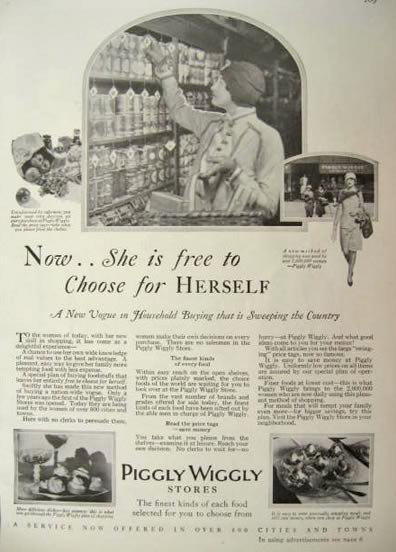
A century later, the same concept of “freedom” to do it yourself has been used to sell other technologies like self-checkout where the customer is expected to do the work that was once done by an employee. And in-store grocery pickup options at places like Kroger, where you can order your groceries online and then an employee will do the shopping for you, aren’t so much a new, revolutionary idea in the industry as they are a return to the way grocery shopping used to work.
Today in Memphis, new technologies are still being tested. Dynasty Brown, a UFCW Local 1529 member, works at Kroger #405 as a picker, one of the workers who shops on a customer’s behalf when the online orders come in. “I like taking the orders out and seeing the smiles on customers faces,” says Brown. A hundred years of progress in technology haven’t changed workers’ pride in providing good customer service, nor shoppers’ appreciation of someone who goes the extra mile for them.
Good technology vs. bad customer experience
As anyone who has ever stood helpless at a self-checkout while it yelled at them about an “unknown item in the baggage area” knows, the “freedom” to do the work yourself isn’t always so free feeling.
A recent article in Gizmodo, “Why Self-Checkout Is and Has Always Been the Worst,” does a pretty great job articulating the difference between good and bad technology, namely that bad technology is the stuff that gets rammed down our throats that no one really wants but we are stuck putting up with anyway:
“For every automated appliance or system that actually makes performing a task easier—dishwashers, ATMs, robotic factory arms, say—there seems to be another one—self-checkout kiosks, automated phone menus, mass email marketing—that actively makes our lives worse.
…
Nobody likes wading through an interminable phone menu to try to address a suspect charge on a phone bill—literally, everyone would rather speak with a customer service rep. But that’s the system we’re stuck with because a corporation decided that the inconvenience to the user is well worth the savings in labor costs.”
But as the article goes on to point out, the promised savings on labor costs for trading out real customer service is often just a long-con by the folks selling the machines.
Customers have been rejecting full automation since 1937
Though the announcement of Amazon Go, Amazon’s grocery store model intended to allow shoppers to enter and exit the store without having to make a single human interaction with anyone, made a big splash when it was announced, the first fully-automated self-service grocery store, Keedoozle, was actually opened in 1937 by the same man who started Piggly Wiggly. Unlike Piggly Wiggly, which still operates today (and where many UFCW members work), Keedoozle was a miserable failure.
Items were kept in separate glass cases so as to be easily seen and never handled. Entering customers received an aluminum “key” with a roll of ticker tape attached. They shopped the product windows as they pleased, slipping their key into slots in the displays and pressing buttons that punched Morse code-like data about their desired products. At the checkout, a shopper handed her key to the clerk, who simultaneously rung up the receipt and transmitted the key’s record to a backroom. There, workers bundled orders and sent them out to customers via conveyer belt. ‘It can’t miss. It’s the biggest thing I’ve ever had,’ Saunders told Time magazine. –Americans Have Been Cursing at Automated Checkouts Since 1937
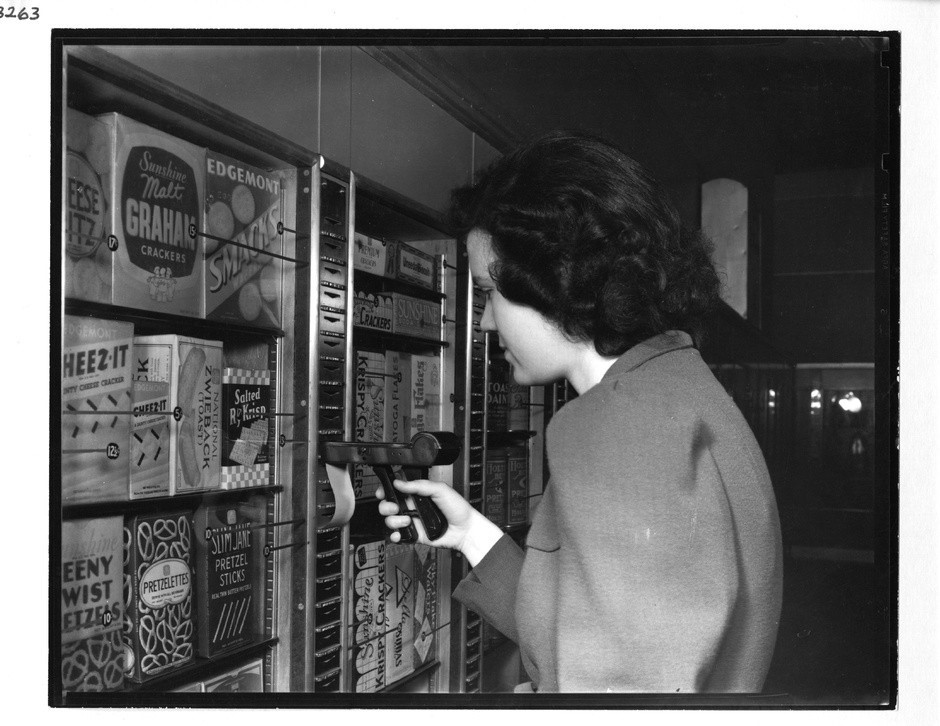 Only it did miss, hard. The last Keedoozle closed in 1949. Saunders wasn’t deterred and went back to work to find even more ways to eliminate more jobs within the grocery store, this time by using an early computer in place of a cashier. Saunders died before the concept got off the ground.
The invisible human labor behind automation
Data & Society’s report, “The Labor of Integrating New Technologies,” finds that rather than replacing jobs, the role out of new shopping technology actually relies heavily on skilled customer service abilities of workers, but those efforts are often invisible and not compensated:
“We find that retail experiments, like self-checkout or customer-operated scanners, tend to rely on humans to smooth out technology’s rough edges. In other words, the “success” of technologies like self-checkout machines is in large part produced by the human effort necessary to maintain the technologies, from guiding confused customers through the checkout process to fixing the machines when they breakdown to quite literally searching for customers aisle by aisle when GPS systems fail. The impact of these retail technologies has generally not been one of replacing human labor. Rather, they enable employers to place greater pressures on frontline workers to absorb the frontline risks and consequences of cost cutting experiments. Much of the work that employees must do on the ground to facilitate new systems is often invisible and undervalued, even as popular perceptions of automation frame these roles as increasingly obsolete.”
The report even points out that senior employees are often needed with advanced skills in “diffusing anger” to help customers navigate new systems and all the bugs that come along with them. But in all the conversations about new technology, this work is swept to the side and seen as exceptional rather than an integral part of both roll out and continued function of self-service technologies.
The report lines up with first-hand accounts from UFCW members who work in stores where new technologies like Kroger’s Scan, Bag, Go program have been tested. Scan, Bag, Go allows shoppers to use scanners they carry around the store with them to scan products as they shop. Edith Peck, a UFCW Local 1529 member who has worked at Kroger in Memphis for the past nine years and who says providing good customer service is her favorite part of the job, says that for the most part, customers just ignore the scanners.
“I think this whole thing is Kroger’s scheme to eliminate employees to compete with automation, but at that point, why not shop at Walmart?” says Peck. “They need to understand good customer service is what is going to set us apart.”
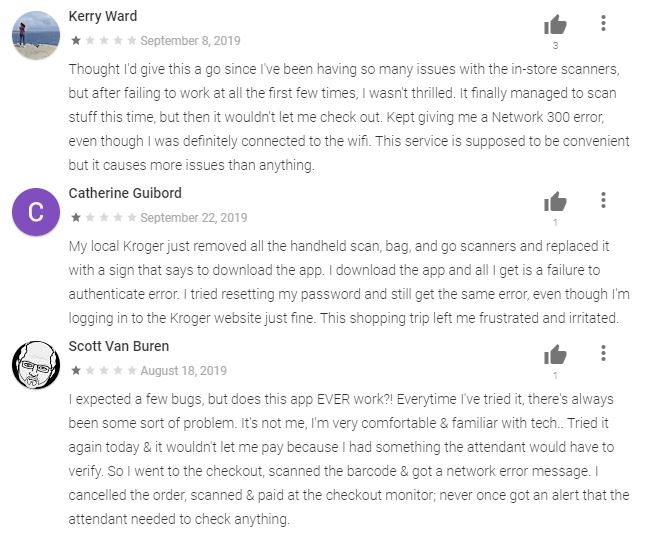
Customer sentiment towards scan and go shopping is pretty clear in the Scan, Bag, Go app, which has a 1.9 star rating in the Google Play store. Reading the reviews paints a clear picture of why “diffusing anger” would be a skill needed to help transitioning customers.

Genuine interaction with cashiers makes us happier
Beyond just the importance to a business’s bottom line, when we talk about the elimination of customer service jobs, it’s also worth remembering to ask: what is it that we want our lives to look like?
A 2013 study, Is Efficiency Overrated?: Minimal Social Interactions Lead to Belonging and Positive Affect, found that that when people engage with cashiers in a genuine way (with a smile, eye contact, brief conversation, etc.), it lifts their mood and leads to an increased sense of belonging. Although people often report reluctance to have a genuine social interaction with a stranger, those interactions still are ultimately good for us. Surprise, just like exercise or eating healthier food, talking to strangers turns out to be a thing we don’t think we want but that makes our lives better when we go out and do it.
Are we comfortable with creating a society where we only interact with products and rarely with flesh and blood people? And given that the answer from most people is a resounding no, how can we effectively push back against technology and innovation that might cross that line while still embracing technology that does improve our lives? If we are so collectively stressed out that saving a few moments waiting in line at the checkout seems like a good trade for someone’s job or our own mental health, perhaps the solution isn’t in improving the efficiency of the shopping experience. Maybe it’s tackling why we’re all so stressed out to begin with.
In the meantime, thank you to all the hard-working UFCW members out there ready to help customers feel seen and appreciated in whatever ways they can, whether it’s service with a smile or repeatedly coming to our rescue at the self-checkout machines. We need you now more than ever.
The post Good customer service is especially vital during shifts in retail technology appeared first on The United Food & Commercial Workers International Union.
]]>The post Should we be worried about dynamic pricing in retail? appeared first on The United Food & Commercial Workers International Union.
]]>Ever go to tell a family member or a friend about a great deal you found online, but when they go to buy it too, it’s no longer there? Or maybe it costs way more than you paid for the same thing?
While you got a great deal, what you’re experiencing is the phenomenon known as “dynamic pricing” or raising and lowering prices many times a day, a week or a month to drive sales but still ensure a consistent profit. This is often paired with what is called “personalized pricing” or “cohort pricing” where each shopper gets their own price for a product – what’s my price isn’t yours and vice versa. These are marketed to consumers as a benefit – deeper discounts just for you — but in the end, may actually end up benefiting the retailer at your expense.
One paper from MIT’s Sloan School says that “Implementing DP can improve revenues and profits by between 8% and 25%.”
So if everyone is saving, how are retailers making money? In the case of things like groceries, people tend to buy the same items over and over again. Since you’re not the only shopper, companies like Amazon sometimes charge one shopper triple what another one pays for the same item.
Companies are able to get away with doing this because as customers, we don’t actually have a single price we’re willing to pay, we have what’s called a “latitude of price acceptance.” That’s a band of prices—from a steal to a little pricey—that we’re willing pay for an item. According to McKinsey & Co., that price variance can be as much as 17% , which is a lot of extra money to be made if you move to the top of the band.
The Impact of Artificial Intelligence
While price fluctuations aren’t new and dynamic pricing has been around since the 1980s, having those changes determined by Artificial Intelligence, or AI, is uncharted territory. As retailers battle it out to find that exact pricing sweet spot that maximizes both sales and profits, evolving technology raises concerns about what the effects are on both consumers and smaller businesses when large companies like Amazon use AI and algorithms to enhance profitability with little oversight.
Data is King
AI-driven personalized pricing relies on tracking and retaining information on customer behavior. That means whoever has the most information on you has a competitive advantage over their rivals. Beyond the security and privacy concerns of big data, this also means that the playing field is tipped even further in the favor of large companies like Amazon, who reached over 100 million Prime members in the US in January.
According to Amazon’s Privacy Notice page, the retail giant collects and analyzes everything from purchase histories and products viewed or searched for to reviews, wish lists and length of visits to certain pages. This huge pool of data on its customers’ shopping habits can help Amazon better understand what shoppers are looking for, what they buy and what prices they are willing to pay.
Increasingly, company leaders are recognizing that a dynamic pricing strategy supported by big data and artificial intelligence (AI) can help them gain a competitive pricing advantage over rivals.
With deep insights into the personal preferences and online behavior of about a third of the US population, not even including the shoppers who are not Prime members, Amazon isn’t just a retailer, but a data company.
Pricing based on who you are
While the law prohibits assigning prices based on protected characteristics—like race or gender—personalized pricing is by its nature nontransparent, meaning you can’t see everyone’s prices. That means you may not know that women, for example, are charged more for the same item, because the only price you see is the artificially high one. If we know companies have information on your race or gender, and we also know the AI-driven dynamic pricing responds to your unique set of data and characteristics, how would anyone know if the law was being violated?
What comes next?
We don’t know—and we’re not sure anyone else does either. But we also believe that honesty and transparency are essential. Lawmakers should be wary of technology evolving faster than our laws, or the ability to enforce them, can keep up with, especially if that technology is skewed to benefit powerful retail industry players like Amazon.
The post Should we be worried about dynamic pricing in retail? appeared first on The United Food & Commercial Workers International Union.
]]>The post Economic Change Is Reshaping America’s Workforce, New Report Finds appeared first on The United Food & Commercial Workers International Union.
]]>A rapidly changing, knowledge-based economy is influencing the way U.S. workers are looking at training and job security, according to a new report from the Pew Research Center.
The report, titled The State of American Jobs, shows that occupations requiring skills and education has increased by 68 percent since 1980. American workers are well aware of shifting economic trends, and believe they will need continuous training to keep pace with a rise in jobs requiring social and analytical skills. According to the report, about 63 percent of Americans believe they have less job security than they did decades ago due to several factors, including an increased outsourcing of jobs and imports of foreign products; an increased use of temporary or contract workers; and the decline of union membership.
The report was conducted in association with the Markle Foundation, and was based on a national survey conducted among 5,006 U.S. adults between May 25 and June 29, 2016. A full copy of the report can be found here.
The post Economic Change Is Reshaping America’s Workforce, New Report Finds appeared first on The United Food & Commercial Workers International Union.
]]>