The post Protecting the Safety and Health of Poultry-Processing Workers appeared first on The United Food & Commercial Workers International Union.
]]>
Adapted from DOL Blog
For some workers, a simple trip to the bathroom could result in the loss of a job.
Poultry-processing workers are sometimes disciplined for taking bathroom breaks while at work because there is no one available to fill in for them if they step away from the production line. Some workers have reported that they wear diapers and restrict liquid intake in an effort to avoid using the bathroom.
No one should have to work under these conditions. All workers have a right to a safe workplace, and that includes access to readily available sanitary restroom facilities on the job.
Luckily, there are very clear standards on this issue: the Occupational Safety and Health Administration requires employers to provide all workers with sanitary restrooms and prompt access to the facilities when needed. Further, employers may not impose unreasonable restrictions on employee use of toilet facilities. These standards are intended to ensure that workers do not suffer adverse health effects that can result if toilets are not sanitary or are not available when needed.
Poultry processing is one of the most dangerous industries in the United States, and readily accessible restrooms is only one of many problems that workers in this industry face. OSHA has found workers exposed to serious hazards in poultry processing plants, including exposure to dangerous chemicals and biological hazards, high noise levels,unsafe equipment, and slippery floors.
Poultry workers are twice as likely to suffer serious injuries on the job as other private industry workers and almost seven times more likely to contract a work-related illness. They are also at particularly high risk of developing musculoskeletal disorders from the repetitive motions they perform on the job, with workers twice as likely to have a severe wrist injury and seven times as likely to develop carpal tunnel syndrome than the average U.S. worker.
These injuries and illnesses must stop. To protect workers in poultry plants, OSHA launched regional emphasis programs targeting these facilities throughout the Midwest, Southern, and Southeast states. Their goal is to reduce injuries and illnesses through outreach and enforcement activities, such as training sessions, public service announcements and targeted, comprehensive safety and health inspections.
With UFCW representation, these workers also have better odds because they have a voice on the job, and can speak up when they see unsafe conditions without fear of retribution. We often work with OSHA to ensure our poultry workers continue to work at safe jobs.
Learn more about their work to protect poultry processing workers.
The post Protecting the Safety and Health of Poultry-Processing Workers appeared first on The United Food & Commercial Workers International Union.
]]>The post Chemtrade Solutions Workers Join the ICWUC appeared first on The United Food & Commercial Workers International Union.
]]>
On June 28, workers at Chemtrade Solutions in Odem, Texas, voted unanimously to join the International Chemical Workers Union Council (ICWUC) of the UFCW. The workers wanted better wages, a safer work environment and a voice in their workplace. Chemtrade Solutions is a supplier of water treatment chemicals for municipalities. This is the second election the ICWUC has won unanimously in the last ten months since the DuBois Chemicals victory.
“The ICWUC organizing department is an organizing machine, and we’re working hard to make the lives of our members and soon to be members better,” said ICWUC President Frank Cyphers. “We welcome the Chemtrade Solutions workers to our union family.”
The post Chemtrade Solutions Workers Join the ICWUC appeared first on The United Food & Commercial Workers International Union.
]]>The post SLS Car Wash Workers Latest to Vote to Join RWDSU/UFCW appeared first on The United Food & Commercial Workers International Union.
]]>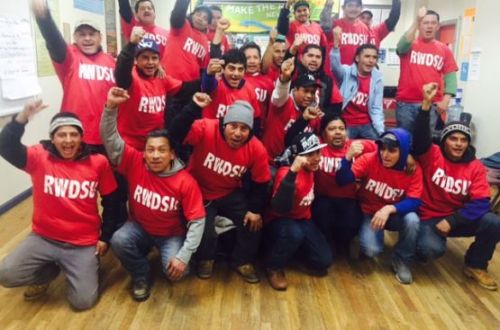
The workers at SLS car wash in Bushwick in Brooklyn, New York, have seen the difference that union membership has made for hundreds of car wash workers in New York City since the Car Wash Campaign began in 2012. Now, they’ve made SLS Car Wash the 11th car wash facility in New York, where workers are represented by the RWDSU/UFCW. SLS, also known as Atlantis Wash & Lube, has about 50 workers and is the largest car wash in the country to unionize. Nine shops have signed contracts.
Determined workers and RWDSU/UFCW organizers braved the cold winter during the organizing drive. By handing out information and talking with workers, the organizing leaders were able to rally increasing support. Workers voted overwhelmingly in favor of joining the union. They wanted a change after years of mistreatment.
“Before we organized a union we worked under a lot of stress,” SLS worker Cheik Umat Balde said. “The managers will always yell at us to work faster. Sometimes they will call us stupid. We had to deal with unknown chemicals with no protections. Now, with a union we will be protected – but most importantly, we will have respect and dignity, and that to me is priceless.”
A coworker, Ramon Carcamo, who has been at SLS for six years said, “I decided to organize with my coworkers to change the working conditions at the car wash because I knew that we had rights that we were not getting. Now, with a union, the car wash managers will have to treat all of us with respect. We knew that if we were united, no one could silence our voice for justice and claim our rights at work.”
The Car Wash Campaign, a coalition of New York Communities for Change, Make the Road New York and the RWDSU/UFCW, have been advocating on behalf of workers in New York City’s largely unregulated car wash industry for nearly four years.
The post SLS Car Wash Workers Latest to Vote to Join RWDSU/UFCW appeared first on The United Food & Commercial Workers International Union.
]]>The post Workers at Heritage WTI Say Yes to a Union Voice with the ICWUC appeared first on The United Food & Commercial Workers International Union.
]]>
By a more than 4 to 1 margin, workers at Heritage WTI in East Liverpool, Ohio, have voted to form a union with the International Chemical Workers Union Council (ICWUC) of the UFCW. Operations workers at the company, who perform hazardous incineration, finally prevailed in their union effort on November 20 after two previous unsuccessful organizing drives.
Jeff Owens, a 14-year veteran of the plant, partially credited recent legal changes that enabled just the operations workers to form a union and a shortened election period that didn’t let the company intimidate workers into voting “no” with their victory.
“We stuck together and knew what the company had done last time. They spread falsehoods and negativity about the union, but when we voted no they proceeded to systematically reduce our benefits and pay, so we knew they weren’t telling the truth,” said Owens. “We just wanted to be treated with respect and be recognized for the extremely dangerous work we do.”
Workers at the plan use a huge incinerator, or kiln, to dispose of chemicals and waste that most people don’t even want to come near.
“By forming our union, we’re going to stand up for better wages and better benefits,” said Owens. “We’re going to be able to support our families better and get the compensation we’ve earned for our hard work.”
The post Workers at Heritage WTI Say Yes to a Union Voice with the ICWUC appeared first on The United Food & Commercial Workers International Union.
]]>The post Remembering Fallen Workers on Workers Memorial Day appeared first on The United Food & Commercial Workers International Union.
]]>
Every year on April 28—Workers Memorial Day—the UFCW joins workers in the U.S. and around the world to remember and pay tribute to the thousands of workers who have been killed on the job and the millions of workers who have suffered from injuries, sickness or diseases in their places of work.
While the efforts of union members and their families have resulted in significant workplace safety laws, including the passage of the mine safety law and the Occupational Safety and Health Act, too many workers are still suffering or dying on the job. According to the Bureau of Labor Statistics, over 4,000 workers lost their lives on the job in the U.S. in 2013 alone. And according to the Occupational Safety and Health Administration, 50,000 workers die from illnesses caused by exposure to chemicals and other workplace hazards and millions more will suffer non-fatal workplace injuries each year.
Although the Obama Administration has taken action to strengthen safety and health protections, including proposing new safeguards on silica and other workplace hazards, Republican lawmakers and their corporate backers are trying to stop these protections and shut down all future regulations. Republican lawmakers are also supporting right-to-work laws, which make it harder for unions to bargain for workplace safety protections, along with decent wages and benefits. In addition to political obstacles, our country’s growing wealth gap and low-wage, part-time economy has emboldened many employers to cut corners, violate workplace safety laws, and punish those workers who report job hazards or injuries.
On Workers Memorial Day and every day, the UFCW stands with workers who are fighting to uphold their basic rights – including safe jobs, workplace fairness and collective bargaining. Working people deserve a safe place to work, and those politicians and corporations that weaken work safety laws and exploit workers for profit and put them in danger must be held accountable.
Workers Memorial Day Resources:
The post Remembering Fallen Workers on Workers Memorial Day appeared first on The United Food & Commercial Workers International Union.
]]>The post The BPA Act: Fighting Breast Cancer among Women in Manufacturing appeared first on The United Food & Commercial Workers International Union.
]]>
Even today, women who work in middle-class jobs across America face pronounced barriers and gender discrimination in the workplace, as exemplified by the recent Demos report on gender inequality in retail wages. However, workplace inequality can manifest in other, more subtle ways – such as the manufacture of products containing Bisphenol-A, or BPA.
BPA is an endocrine disrupting chemical, which alters hormone production and behavior, disrupting the body’s normal functions. In a 2012 six-year study, BPA was found to have a pronounced effect on women who work in the automotive plastics and the food packaging industries.
These women are five times more likely to have breast cancer than women who work in other industries.
BPA, which is found in the epoxy lining of the metal food can and released into the air during the food canning process, was banned by the FDA in the manufacture of baby bottles, sippy cups and infant formula packaging. Many private companies have taken further steps to remove BPA from products. However, BPA exposure is still a problem for thousands of manufacturing and packaging workers in America.
In order to address this problem, the UFCW has joined allies such as the Communications Workers of America, the United Steelworkers, and the United Automobile Workers in supporting the Ban Poisonous Additives Act, or the BPA Act.
The BPA Act would remove BPA from food packaging, encourage the development of safe alternatives, and ensure a thorough safety review of all currently used substances in food and beverage containers. It is currently in committee in the House, where it needs to be passed by the House and the Senate and approved by the President before it becomes a law.
This brochure, produced by the BlueGreen Alliance and UFCW, contains useful information about the growing problem of breast cancer among working women.
The post The BPA Act: Fighting Breast Cancer among Women in Manufacturing appeared first on The United Food & Commercial Workers International Union.
]]>The post CertainTeed Workers Say “Yes” to a Union Voice with the Chemical Workers appeared first on The United Food & Commercial Workers International Union.
]]>
Sweeney, Lance Heasley.
Eighty workers at the CertainTeed drywall plant in Proctor, West Virginia, voted “Union Yes” on June 6 to join the International Chemical Workers Union Council.
Lance Heasley is a former steward and member-activist with UFCW Local 45C and works as an instrument technician at Axiall, where he and his fellow union members make chlorine and other caustic chemicals. Many of them, including Lance, live side-by-side with workers at the CertainTeed and know each other socially. So, when Lance heard his friends and neighbors talk about how hard it could be working at CertainTeed, he started talking to them about the difference a union could make.
He began to go out of his way to have conversations with CertainTeed workers and slowly built a committee of interested workers. He reached out to the ICWUC organizing department and worked with them to sign up CertainTeed workers on authorization cards. Workers began texting and calling each other and holding meetings to talk about the need for a union at CertainTeed. One of those workers was Carl Sweeney.
One of the major issues for Carl was being able to speak up and speak out without fear of retaliation. “I wanted to go to work every day and not worry about what I said or if I’d be the next one out because someone didn’t like me,” said Carl. “I wanted to speak up when I saw something unsafe and know the problem would be fixed, not seeing me as the problem for bringing it up.”
As soon as the CertainTeed workers filed with the National Labor Relations Board for an election, the company brought in an anti-union law firm and began holding mandatory anti-union meetings and one-on-one sessions to persuade workers to back down. But they stood strong and stayed united, despite company attempts at intimidation.
“I knew I could lose my job, but I also knew something had to change,” said Carl. “We had to stick together, stay united, to make CertainTeed a better place to work.”
That work paid off and Carl and his coworkers are looking forward to addressing their concerns at the bargaining table – including rapidly rising healthcare costs, favoritism, and safety concerns in the workplace.
The post CertainTeed Workers Say “Yes” to a Union Voice with the Chemical Workers appeared first on The United Food & Commercial Workers International Union.
]]>The post Member Spotlight: Mechelle Cunningham appeared first on The United Food & Commercial Workers International Union.
]]>In this week’s member spotlight, we’re highlighting the story of another longtime UFCW member, who like last week’s spotlight member, is also from West Virginia.
Local 23 member Mechelle Cunningham caught our attention when we saw how she spearheaded a collection drive at her workplace–Giant Eagle in Morgantown, West Virginia. After hearing about a friend who had donated some water and that trucks were bringing water to people in her state who were affected by the chemical spill in and around Charleston, WV, Mechelle looked at the 3 pallets of water on the store floor in front of her and told her manager she wanted to purchase them and have them removed from the store floor. Her manager, knowing the cost was around $560 dollars, said, “Today?” Mechelle’s response was automatic.

“I didn’t think about the price–I just knew that my fellow employees would gather together to purchase that water to send down there. I told her that one way or another we’d get the money, and we did!” Together, Mechelle, her fellow union members, and other members of the community were able to send 17 pallets of water to those in need.
For Mechelle, being a union member means “standing up for your rights, and helping one another”. When talking with Mechelle, its clear that the ‘helping one another’ part is big for her, as demonstrated by her role in the donation of the water pallets: “We all really help one another and donate for different causes and support each other, and especially with something that large for our community, you know, people not having water–that’s a main thing, you have to have that.”
Mechelle is coming up on her 40th year as a UFCW member and has experienced first-hand how being in a union means there’s always someone there to help–“to back you and support you”. Mechelle finds that oftentimes, many people don’t know about the union, and until they sit down and talk about it, don’t fully understand what it is. “I just have such a strong belief in the union,” says Mechelle, which is why she helps spread the word at work about how people–often younger members who haven’t been through strikes for better working conditions like she has–can protect their rights. By sharing her own experiences as a union member, and how it has helped her, she finds that she is helping them understand, even when there isn’t something currently happening.
Active community members like Mechelle inspire us every day. Do you know a UFCW member whose story we could share? Tell us about them at https://www.ufcw.org/resources/members/share-your-story/
The post Member Spotlight: Mechelle Cunningham appeared first on The United Food & Commercial Workers International Union.
]]>The post Staying Informed and Updated on Your Plant’s Ammonia Safety Program appeared first on The United Food & Commercial Workers International Union.
]]>
Several of our UFCW members who work in meatpacking, poultry and food processing plants spend their days working around refrigeration systems that use ammonia – a Highly Hazardous chemical. It is easy and important for stewards to find out if their company is complying with OSHA’s standards about how to operate safely with Highly Hazardous chemicals. The main standard is Process Safety Management (PSM). PSM gives workers and their representatives the right to ask for information about the ammonia system.
OSHA’s PSM Standard applies to most meat packing, poultry, and food processing plants. One PSM requirement is that the company must conduct an audit of their compliance every three years. Stewards can request to see the recommendations from the past two audits and find out what actions have been taken. By looking at the audit results and the follow-up stewards can see if the company is taking their PSM seriously.
“When I was sent out for training, I received a lot of information about PSM that I realized could be helpful to not only me, but also my co-workers at the plant,” said Jim Oldenburg, a steward at JBS and a member of UFCW Local 1473 in Green Bay, Wisconsin.
Even though every worker at the plant cannot receive specialized PSM training, workers do have the right to stay informed about their plant’s PSM program and come to their stewards with questions or concerns. To help his co-workers at the plant, Oldenburg submitted a list of PSM questions and responses to the company. These questions were developed by the Industrial Refrigeration Consortium at the University of Wisconsin – Madison.
“People look to me to help them and I’m doing everything that I can for them every day. Having this information available is just one of them,” said Oldenburg.
Here are the ten questions Jim submitted to management. According to the PSM standard your company must respond adequately to your concerns. Their responses to these questions can give you a sense of the condition of your plant’s ammonia safety program. If you need help evaluating the company’s response you can email the UFCW Health and Safety Representative for Process Safety Management at bthielen@www.ufcw.org.
1. When was our last compliance audit?
2. Can you show me the closeout of recommendations from the last compliance audit?
3. Can you provide me a copy of the most recent incident report and documentation that shows how we closed out recommendations/from the incident report?
4. When was our last Process Hazard Analysis (PHA) conducted and can you show me documentation that closes out the recommendations from the last PHA?
5. How often do we certify our plant’s written operating procedures for the covered process?
6. What training program do we have for our operators and what are the means used to verify they have understood the training?
7. How often do we do refresher training?
8. Based on our plant’s mechanical integrity program, what is the next piece of equipment scheduled for retirement and when is it scheduled to come out of service?
9. What criteria do we use to evaluate contractors that work on our covered process?
10. What was the last change made to our system and can you show me the documentation for that change?
The post Staying Informed and Updated on Your Plant’s Ammonia Safety Program appeared first on The United Food & Commercial Workers International Union.
]]>