The post UFCW Celebrates Black History Month: Bayard Rustin–An Overlooked Champion of Civil and Labor Rights appeared first on The United Food & Commercial Workers International Union.
]]>One of the greatest moments of the Civil Rights era was the March on Washington in 1963–one of the largest non-violent protests to ever occur in America. The March on Washington brought thousands of people of all races together, in the name of equal rights for everyone–whether they were black or white, rich or poor, Muslim or Christian. Dr. Marin Luther King, Jr. made one of his most inspiring and famous speeches at the march, which culminated on the National mall.
But history has often overlooked the man who was the driving force behind this monumental event–a man named Bayard Rustin. Rustin was the one who organized the march, bringing methods used by Gandhi as well as the Quaker religion to Washington to ensure peace, but also impact. It was Rustin who helped shape Dr. King into the iconic symbol of peace he is remembered as.
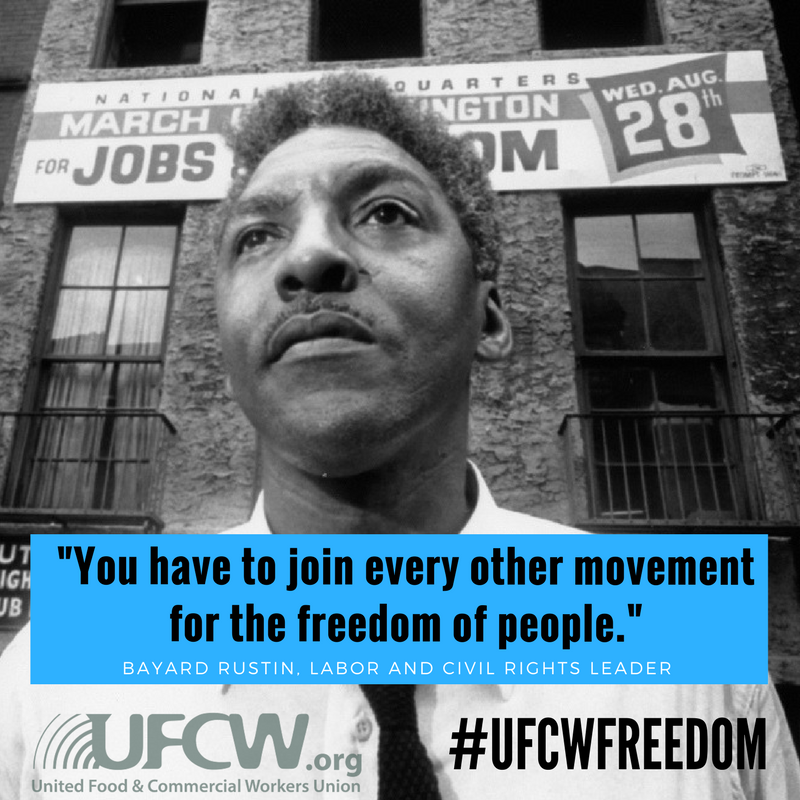
As a young adult, Rustin worked with many kinds of people who influenced his activism, including ministers and labor organizers. During World War II, Rustin fought against racial discrimination in war-related hiring, and was later jailed for two years after refusing to enter the draft. Then, after protesting segregated transit systems, he was sentenced to work on a chain gang for several weeks.
Despite being punished for his beliefs, Rustin continued to work towards changing things for the better. In 1953, Bayard Rustin arrived in Montgomery, Alabama to partake in the famous bus boycott that kicked off after Rosa Parks was arrested after refusing to give up her seat on the bus for a white man. The boycott brought many civil rights leaders to the area, including a young Dr. Martin Luther King, who had not yet embraced non-violence. But Rustin taught many who were partaking in the boycott how Gandhi had used peaceful tactics to bring change in India, and people saw the importance of these tactics, and began to embrace them, focusing on direct protest.
Rustin was also a champion of workers rights. In 1965, Rustin and his mentor A. Philip Randolph co-founded the A. Philip Randolph Institute, a labor organization for African-American trade union members. Much of his work emphasized that labor rights were an integral part of the civil rights movement.
Although Bayard Rustin was a tireless activist, his life achievements are unknown to many, and he has even been called the “lost prophet” of the civil rights movement. This is largely because not only was Rustin silenced and threatened like many others were for being a black man speaking out for equal rights, but also because he was openly gay in a time when homophobia and bigotry was rampant. Rustin continued his life as an openly gay man, even after being incarcerated for it, and is seen as a champion of the LGBT movement still today. Despite being beaten, arrested, jailed, and fired from various leadership positions, Rustin overcame and made a huge impact on the civil and economic rights movements.
America has a long way to go before Rustin’s dreams of equal human rights for all are achieved, but without him, we perhaps would not be where we are today. Today, we have a black president, more women in leadership positions, and more of legislation in the states overturning old and outdated laws barring gay couples from marrying. These are just a few examples of the progress our country has made since Rustin’s time, and working people will continue to work so that ALL people have equal rights–at work and at home.
The post UFCW Celebrates Black History Month: Bayard Rustin–An Overlooked Champion of Civil and Labor Rights appeared first on The United Food & Commercial Workers International Union.
]]>The post Women’s History Month: UFCW Celebrates the Life of Addie Wyatt appeared first on The United Food & Commercial Workers International Union.
]]>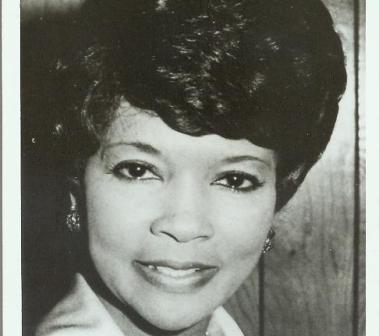
Women’s History Month gives us an opportunity to pay tribute to Addie Wyatt, who fought for workers’ rights during the height of the American Feminist Movement and changed the face of organized labor.
Addie Loraine Cameron, better known as Addie L. Wyatt (1924 –2012), was born in Mississippi and moved to Chicago with her family in 1930. When she was 17 years old, she married Claude S. Wyatt, Jr.
She began working in the meatpacking industry in 1941. Although she applied for a job as a typist for Armour and Company, African American women were barred from holding clerical positions and she was sent to the canning department to pack stew in cans for the army. Due to a contract between Armour and the United Packinghouse Workers of America (UPWA), she earned more working on the packinghouse floor canning stew than she would have made working as a typist, and joined the UPWA after learning that the union did not discriminate against its members.
In 1953, she was elected vice president of UPWA Local 56. In 1954, she became the first woman president of the local, and was soon tapped to serve as an international representative. She held this position through the 1968 merger of UPWA and the Amalgamated Meat Cutters and Butcher Workmen until 1974, when she became director of the newly formed Women’s Affairs Department. In 1970s, she became the first female international vice president in the history of the Amalgamated Meat Cutters and Butcher Workmen and later served as director of its Human Rights and Women’s Affairs and Civil Rights Departments. She served as the first female African American international vice president of the UFCW after Amalgamated and the Retail Clerks International Union merged in 1979.
She and her husband were ordained ministers and founded the Vernon Park Church of God in Chicago. She played an integral role in the civil rights movement, and joined Dr. Martin Luther King, Jr. in major civil rights marches, including the March on Washington, the march from Selma to Montgomery, Alabama, and the demonstration in Chicago. She was one of the founders of the Coalition of Labor Union Women, the country’s only national organization for union women. She was also a founding member of the Coalition of Black Trade Unionists and the National Organization of Women.
In 1984, Addie Wyatt retired from the labor movement as one of its highest ranked and most prominent African American and female officials. In honor of her work, she was named one of Time magazine′s Women of the Year in 1975, and one of Ebony magazine′s 100 most influential black Americans from 1980 to 1984. The Coalition of Black Trade Unionists established the Addie L. Wyatt Award in 1987. She was inducted into the Department of Labor’s Hall of Honor in 2012.
The post Women’s History Month: UFCW Celebrates the Life of Addie Wyatt appeared first on The United Food & Commercial Workers International Union.
]]>The post Black History Month Member Profile: Hidi Frazier of Local 1996 appeared first on The United Food & Commercial Workers International Union.
]]>
As the UFCW continues to honor Black History Month and reinforces its commitment to racial and economic justice, we’re asking members why these issues matter to them. Hidi Frazier of Local 1996 has worked for Kroger in Georgia for 15 years. As a Deli Manager, she oversees both the deli and bakery, trains new associates, takes inventory, and makes orders.
[aesop_quote type=”pull” background=”#282828″ text=”#ffffff” width=”30%” align=”right” size=”2″ quote=”A lot of issues affects us all in one way or another. We all want fair wages, good health benefits and good pensions. We all have to continue to stand together and keep working families strong.” cite=”Hidi Frazier, UFCW Local 1996″ parallax=”on” direction=”left”]
Hidi says that to her, “Black History Month … is about honoring and remembering those who made a difference and paved the way for people like me. Without their sacrifice and determination to want and fight for change, I wouldn’t be where I am today.”
Hidi first became active in her union seven years ago when a fellow member asked if she’d like to volunteer with phone banking to ask fellow members to vote and help get labor-friendly candidates elected in her state who will make a difference for working families. She agreed, and has been an active member ever since.
During her time volunteering, Hidi was inspired by Mary Lou Romaine-Waymer, who leads and organizes the phone banks and other political activities for the local: “She does a great job. Mary Lou Wagner is a leader for UFCW. She keeps the members well informed in local and state politics. Mary Lou reminds us that these races are the most important because they affect our everyday lives as citizens of Georgia.”
After seeing first-hand just how much of a difference being part of union family makes in her life, Hidi wants to spread the word. As a manager, she’s in a unique position to help explain to her fellow coworkers what the union is all about. “I would advise everyone, not just African Americans, to become involved. A lot of issues affects us all in one way or another. We all want fair wages, good health benefits and good pensions. We all have to continue to stand together and keep working families strong,” she says
[aesop_quote type=”pull” background=”#282828″ text=”#ffffff” width=”30%” align=”left” size=”2″ quote=”When union members, community members, and other working people come together, we are more powerful.” parallax=”on” direction=”left”]
Hidi also stresses the importance of solidarity. “We have the AFL-CIO, where all the unions come together to keep the fight going for working families,” she says. “When union members, community members, and other working people come together, we are more powerful. Labor and civil rights intersect by continuing the fight on issues that affect working families. We will continue to rally and lobby together to make sure that we all have the same opportunities as everyone else. We have to have more training and workshops so that minorities can compete in the workplace. Lastly, we have to make our unions stronger than ever.”

The post Black History Month Member Profile: Hidi Frazier of Local 1996 appeared first on The United Food & Commercial Workers International Union.
]]>The post Black History Month Member Profile: David Montgomery of Local 655 appeared first on The United Food & Commercial Workers International Union.
]]>
As the UFCW continues to honor Black History Month and reinforces its commitment to racial and economic justice, we’re asking members why these issues matter to them. David Montgomery has been with UFCW Local 655 in St. Louis, Missouri for 15 years. David spends his days as the floral warehouse supervisor, coordinating various arrangements to be delivered to Schnucks grocery stores around the city.
[aesop_quote type=”pull” background=”#282828″ text=”#ffffff” width=”30%” align=”right” size=”2″ quote=”My father was always a big union guy and he always told me that it was good to help yourself, but it is great to be able to help others.” cite=”David Montgomery, UFCW Local 655″ parallax=”on” direction=”left”]
David says the value of Black History Month lies in its ability to continue to educate the average American, even himself.
“It’s a time of year to celebrate and acknowledge the wonderful achievements and advancements that have been introduced to most of the world by Black people that many don’t even know about. I still learn something new every February,” David said.
David’s family has union roots, which is what first got David interested not only in a union job, but the labor movement as a whole.
“My father was always a big union guy and he always told me that it was good to help yourself, but it is great to be able to help others,” he said. “I started last year getting really involved, especially in the Fight for 15 rallies. I’ve seen how people from all over can come together for a great purpose.”
For other black workers interested in the labor movement, David has a simple piece of advice.
“Just do it. Just know you are continuing the same fight as legendary leaders that have come before us and you’re helping lay a stronger foundation for generations to come,” he said. “It’s a feeling you can’t put into words.”
David believes that civil rights and labor go hand-in-hand, because without strong union support, workers are open to having their rights violated. The 33-year-old father of three says labor can build lasting positive change in race relations by “building an inclusive and diverse workforce.”
“Labor and civil rights intersect all over the place,” he said.
The post Black History Month Member Profile: David Montgomery of Local 655 appeared first on The United Food & Commercial Workers International Union.
]]>The post Black History Month Spotlight: An Interview with Robin Williams, UFCW International Vice-President appeared first on The United Food & Commercial Workers International Union.
]]>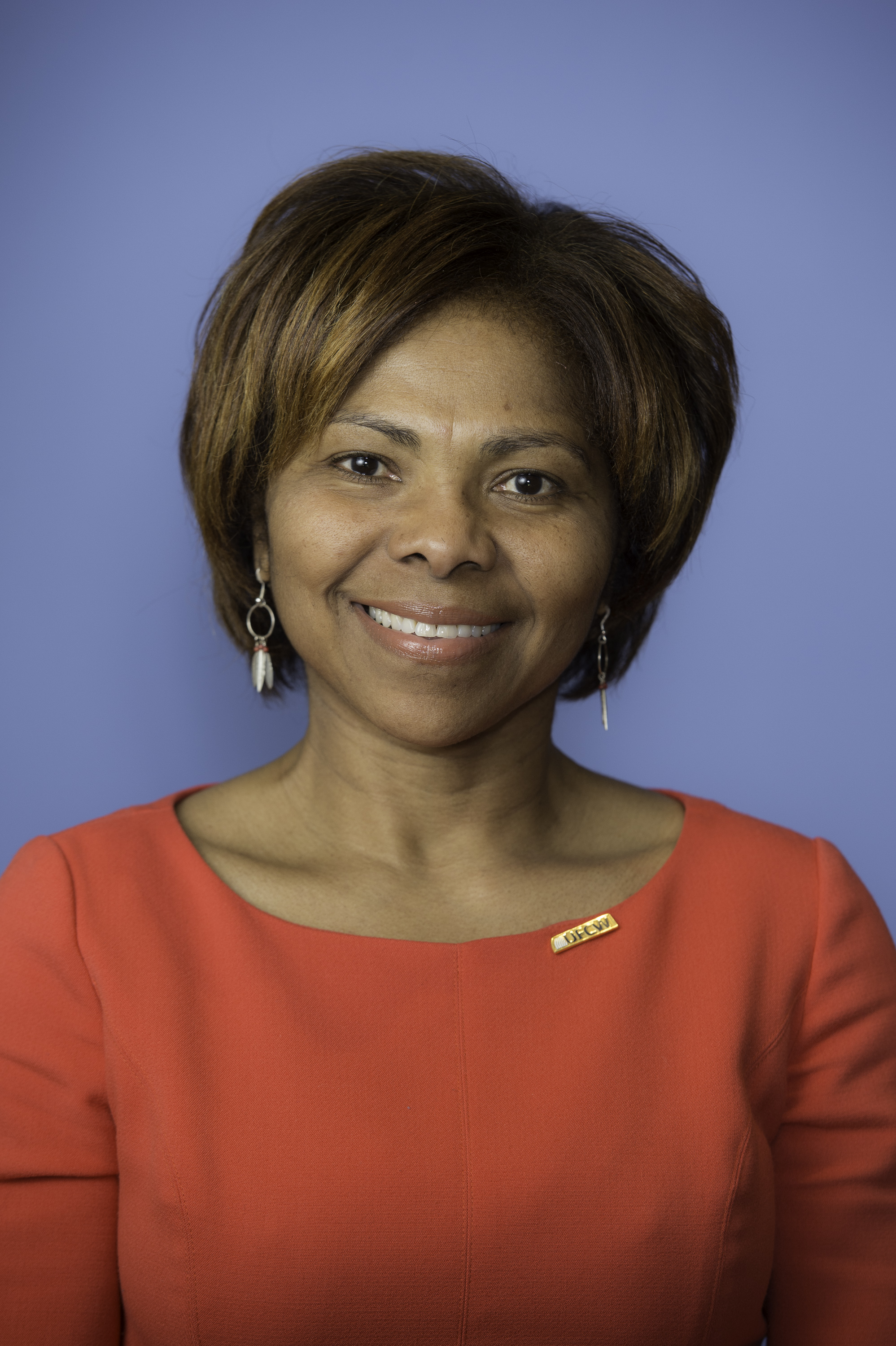
As part of our ongoing celebration of Black History Month, we sat down with UFCW International Vice President and Director of the Civil Rights and Community Action Department Robin Williams to talk about the important relationship of the labor movement and the achievements and contributions made by African Americans.
What does Black History Month mean to you and why is it so important?
Black History Month is about celebrating and being proud of being Black in America. It is a time where we celebrate the contributions that African Americans, past and present, have made in our society. Our country’s rich history has been deeply impacted by so many groups and it’s important we celebrate everyone’s contributions in order to create a tradition of acknowledgement, inclusion and community engagement. By remembering and celebrating our history, we can build awareness on the struggles and challenges that African Americans have faced and inspire a new generation of civil rights and social justice leaders.
How and why did you become involved with the labor movement?
I was born in 1964 in Washington, D.C. and the labor movement, like the civil rights movement, has been a huge part of my family’s history. My father was a minister and supporter of Dr. King and the Southern Christian Leadership Conference. During the 1970’s, he worked for Raleigh’s Clothing Store and Woodward & Lothrop Department Store, which were both represented by The Retail Clerks Local 400, which later became UFCW Local 400. I remember my dad talking about the union organizing campaign and how solidarity and joining the union was so important for the advancement of Black people. It was because of his union job that my father was able to purchase a home and raise his family in a middle class neighborhood in Washington, D.C.
The 1970s in Washington, D.C. was a time where African Americans were gaining more opportunities to land full-time jobs in local and federal government, as well as in healthcare and other public and private sector jobs. With the increase of union organizing in these sectors, worker solidarity and union membership had quickly become the greatest pathway to the middle class for African American workers.
By the time I was hired as a part-time food clerk for Georgetown Safeway Food Store in Washington, D.C. in the early 1980s, the labor movement was a part of me. I got involved in my union, UFCW Local 400, after organizing a delegation of part-time employees to meet with store management in a demand for fair scheduling. I went on to become an assistant shop steward and then I joined Local 400 as a full-time organizer and led the healthcare team in organizing hundreds of healthcare workers in Southern Maryland and Virginia. I joined the UFCW International staff as Associate Director of Civil Rights and Community Action in 2005.
What suggestions do you have for other African Americans who want to become more involved in the labor movement?
I am grounded in my faith, my family, and in my union. My faith teaches me that the most important thing in life is love. My family keeps me connected to who I am and my culture and my union allows me to be in solidarity with mankind and to serve others.
I am proud to be union–UFCW Union! I am proud to be an advocate for workers’ rights. Unions need more active African American union members, organizers, leaders and advocates to get involved in the labor movement. The labor movement remains one of the greatest avenues for economic freedom for African Americans. If you have passion to fight for justice, if you want to work to create a more equitable society–the labor movement could be the place for you.
There are many ways to get involved. If you are a union member, you can start by attending membership meetings and learning more about the activities of your union. You can also volunteer for union organizing campaigns, workplace actions, social media campaigns, participate in Get Out the Vote campaigns, run for union shop steward or run to serve on your contract bargaining team.
If you are not a member of a union, you can get involved in the labor movement by joining a living wage, fair scheduling, sick leave, or other social and economic justice campaigns–apply for intern opportunities, seek out job opportunities. African Americans that desire to get involved in the labor movement can also seek out volunteer, internships and job opportunities with organizations that are in partnership with labor and civil rights organizations, voter engagement, community organizing, LGBTQ organizations, immigration and workers’ right organizations.
In the 60s, activists like Dr. Martin Luther King Jr., Rosa Parks, Bayard Rustin, and Malcolm X led the Civil Rights movement, which also advocated for expanded workers’ rights. In your opinion, what groups or leaders stand out as being at forefront in the fight for equality and justice now?
Leaders like Reverend William Barber, President of the North Carolina NAACP and founder of the “Forward Together Movement,” the Advancement Project, DEMOS, and many African American labor activists, like myself, are now at the forefront in the fight for equality and justice. Through the Labor Commission on Race and Economic Justice, UFCW International President Marc Perrone and Fred Redmon, Vice President of the United Steelworkers, are at the forefront in leading the conversation and work to dismantle racism within the labor movement.
Also, in today’s era of social media, movements like Color of Change, Not One More Deportation, Black Lives Matter, Black Youth Project 100, and the Dream Defenders have sparked a new generation of advocates for racial and social equality. Many of these young leaders are also leading in the labor movement. Alicia Garza, co-founder of Black Lives Matter is Special Projects Director for the National Domestic Workers Alliance, Carmen Berkley, cofounder of Black Youth Project 100, is Human, Civil and Women’s Rights Director for the AFL-CIO, and Greg Cendana is a young, openly gay Asian American activist and Executive Director of the Asian Pacific American Labor Alliance.
Through their civil rights, community and union activity, these millennials are leading the charge to expose and dismantle a racist system that disenfranchises communities of color.
The labor movement has a rich tradition of fighting inequities that extend beyond the workplace. In what way do labor and civil rights intersect and how can unions help narrow the income and equality divide that disproportionately affect African Americans and other minorities?
In a speech entitled “if the Negro Wins, Labor Wins,” Dr. Martin Luther King, Jr. said:
Negroes in the United States read this history of labor and find it mirrors their own experience. We are confronted by powerful forces telling us to rely on the good will and understanding of those who profit by exploiting us…. They are shocked that action organizations, sit-ins, civil disobedience, and protests are becoming our everyday tools, just as strikes, demonstrations and union organization became yours to insure that bargaining power genuinely existed on both sides of the table… Our needs are identical with labor’s needs: decent wages, fair working conditions, livable housing, old age security, and health and welfare measures… That is why Negroes support labor’s demands and fight laws which curb labor. That is why the labor-hater and labor-baiter is virtually always a twin-headed creature spewing anti-Negro epithets from one mouth and anti-labor propaganda from the other mouth.
These words stand true even today: the success of the civil rights movement as well as the labor movement is the ability to work together in order to move a vigorous agenda that addresses institutional and generational racism, worker exploitation, and social and economic inequality.
Just as Black Lives Matter and today’s Black Liberation movement share agendas that include workers’ rights and union protections, the labor movement must adopt and move a robust civil rights agenda that includes the voices of Black, Latino, Women, Asian, and LGBTQ workers. It must be an agenda that moves campaigns to declare that all workers can earn a better wage, regardless of the level of their education. All workers have a right to paid sick leave and paid family leave. An agenda that works to protect all workers against discrimination based on the color of their skin, their nationality, their self-identity or sexual orientation, or past incarceration or criminal record. Labor should move an agenda that promotes equal pay for all workers regardless of gender, their place of employment or past criminal record. Labor should move an agenda that works with the civil rights movement to protect the right to vote for all people.
The work of the Labor Commission on Race and Economic Justice is only the beginning of a process to address discrimination. Labor can no longer be silent about the attacks on Black communities. Labor must become true allies of the civil rights movement. For the enemies of the labor movement are the same enemies of the civil rights movement, and neither movement can win without the other…
With cases like Friedrichs v. California Teachers Association and expansion of Right to Work, labor cannot withstand the attacks on the movement without joining a greater movement for social and economic justice. The two movements must show up for each other, “For in the End, we will not remember the words of our enemies, but the silence of our friends”…words of Dr. Martin King, Jr.
The post Black History Month Spotlight: An Interview with Robin Williams, UFCW International Vice-President appeared first on The United Food & Commercial Workers International Union.
]]>The post Black History Month Member Profile: Local 1208 Steward Daniel Garescher appeared first on The United Food & Commercial Workers International Union.
]]>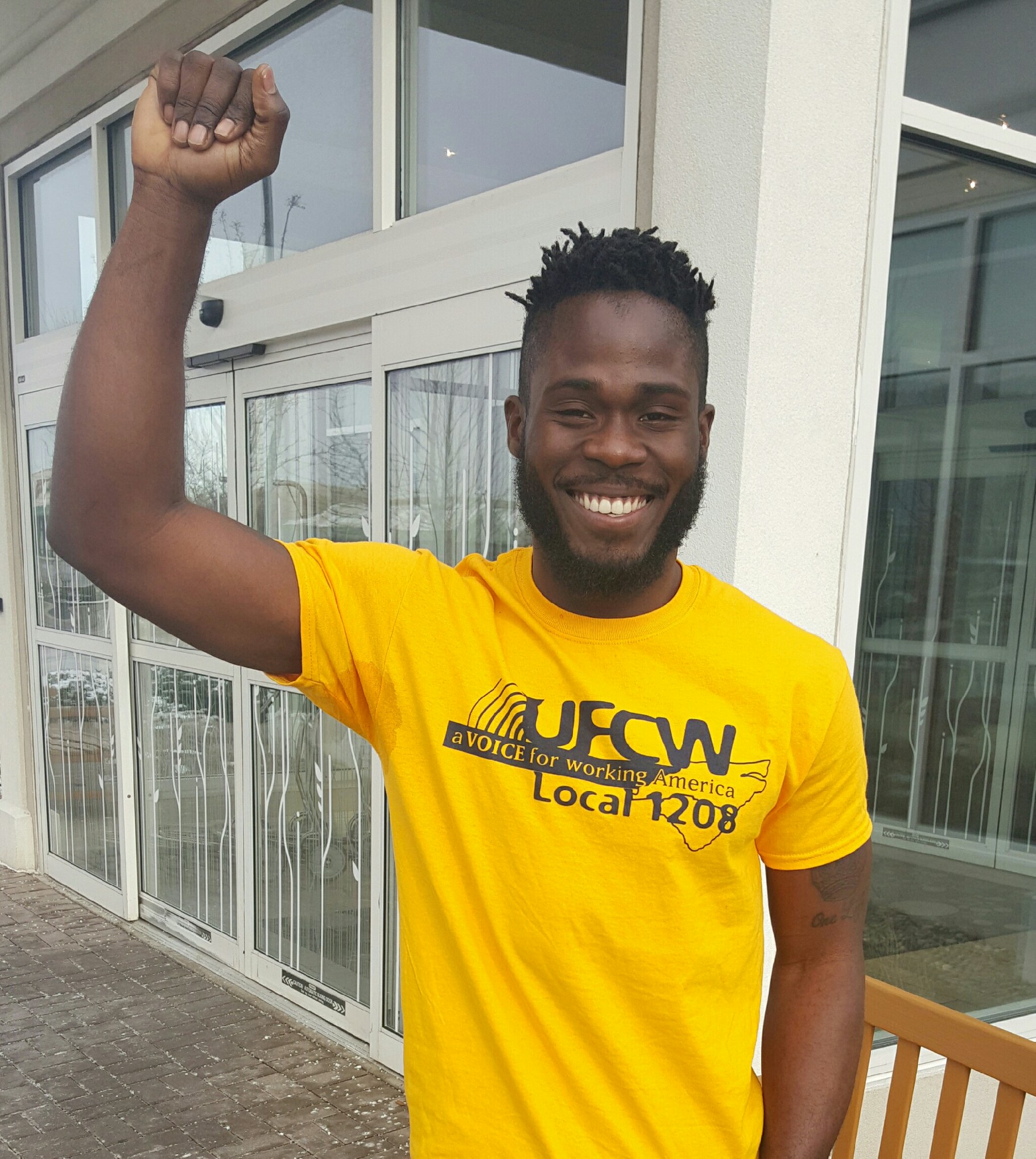
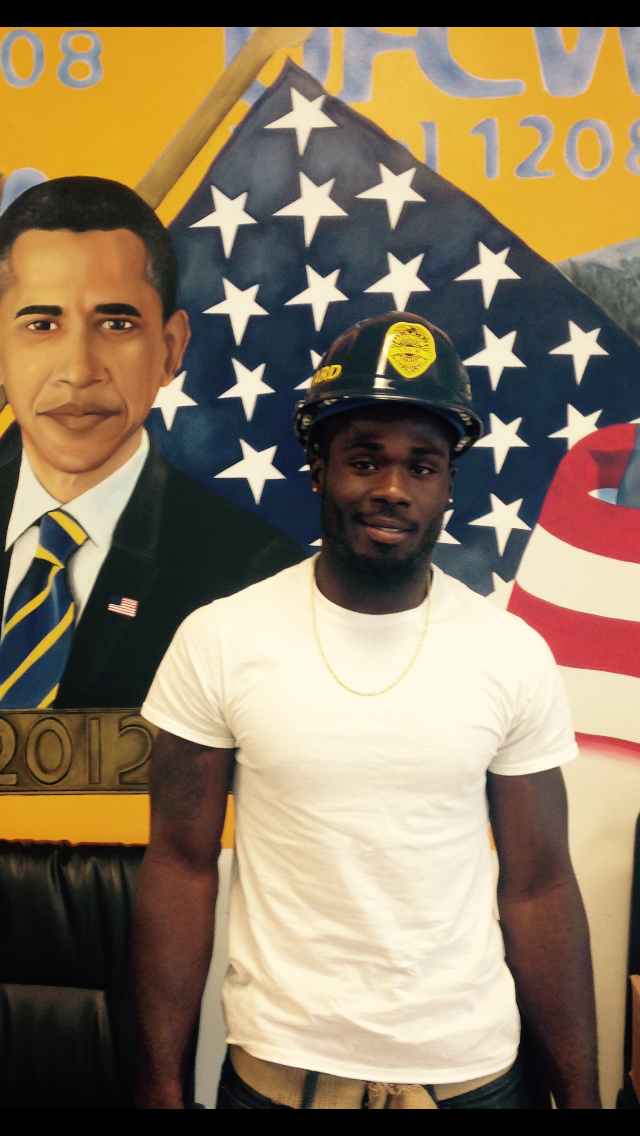
As our UFCW family continues to celebrate Black History Month, we’re asking members why it’s important to them. Daniel Garescher, who is Haitian/Caribbean-American, is a Local 1208 steward at Smithfield Foods in Tar Heel, North Carolina.
To Daniel, Black History Month is important because it sheds light on the history of black Americans, something that “schools and textbooks do not always cover.”
“When the history and culture of black people in America is excluded, African-Americans can feel oppressed–we want to have pride about who we are,” Daniel says. “Without education about all that people of color are and can be–and what contributions they have made–we are reinforcing racism. Black History Month is a small effort to resolve this and counter negative images of black people that were perpetuated in the media and society for so much of our country’s history, and still persist today.”
Daniel got involved in the union because he saw first-hand how being part of a union family improved people’s quality of life, and fought for the rights of all workers, including people of color.
“My mother was working at Smithfield when I was in high school, and I was working as an interpreter for both Smithfield and the union. I started working at the plant myself after high school. I had already seen the value of having a voice at the plant through the union,” he says.
As a steward, Daniel fights every day for his coworkers and urges them to get more involved. His advice to his other union brothers and sisters is to “Sign up! Become a steward. Learn as much as you can and go to any trainings that you can go to. It will help you both at work and outside of work in your future. The union has helped me, a Haitian man, become more of a leader, more of a man.”
Daniel notes that the labor movement has a unique responsibility and is in the position to fight inequalities that extend beyond the workplace: “Workplace education and power is the best way to reduce the income divide. The labor movement can always do more to highlight and promote leaders of color to reduce discrimination–that’s why it’s so important that we not just continue to celebrate Black History Month, but continue to fight for civil rights in our daily work and lives.”
The post Black History Month Member Profile: Local 1208 Steward Daniel Garescher appeared first on The United Food & Commercial Workers International Union.
]]>The post Black History Month: Honoring Fannie Lou Hamer appeared first on The United Food & Commercial Workers International Union.
]]>“Nobody’s free until everybody’s free.” —Fannie Lou Hamer
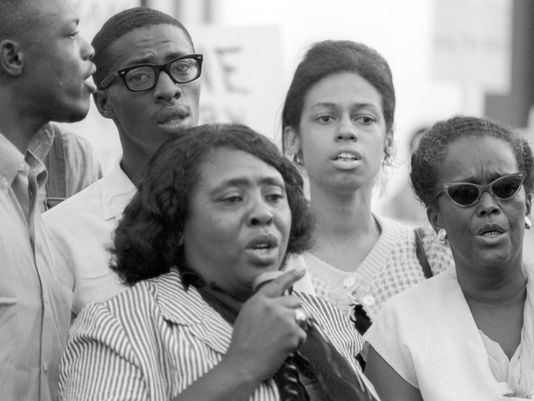
via www.clarionledger.com
Black History Month provides us with an opportunity to pay tribute to Fannie Lou Hamer, a voting and civil rights activist who was instrumental in organizing Mississippi’s Freedom Summer for the Student Nonviolent Coordinating Committee (SNCC), and drawing national attention to the civil rights struggle in Mississippi at the 1964 Democratic National Convention.
Born to a family of sharecroppers in Mississippi in 1917, Fannie Lou Townsend started working in the cotton fields at the age of six. In 1944, she married Perry “Pap” Hamer, and the couple struggled to get by in rural Mississippi.
In 1962, her life changed when she decided to attend a protest meeting, where she met civil rights activists who were in Mississippi to register African Americans to vote. She became active in helping with the voter registration efforts, and became a SNCC field secretary in 1963. That same year, she attended a citizenship training school sponsored by the Southern Christian Leadership Conference in Charleston, South Carolina. On the bus trip back home, after stopping in Winona, Mississippi, Hamer was arrested with other activists after trying to be served at a cafe. She was brutally beaten in jail, and needed almost a month to recover from her near fatal injuries after her release.
In 1964, Hamer worked with the SNCC to organize the Freedom Summer voter registration drive in Mississippi. Later that year, Hamer and other civil rights activists established the Mississippi Freedom Democratic Party (MFDP) in order to fight for fair representation at the Democratic National Convention in Atlantic City, New Jersey. NAACP activist Aaron Henry headed the MFDP delegation, and Hamer served as vice chair.
At the convention, the MFDP lined up witnesses, including Dr. Martin Luther King, Jr., to testify before the convention’s credentials committee in order to gain seats at the convention. Hamer also testified and her testimony gained national attention. Hubert Humphrey, who would become the party’s candidate for Vice President, served as the liaison for President Johnson. Humphrey offered the MFDP delegates only two seats, and the delegates rejected the compromise.
That same year, Hamer ran for Congress in Mississippi, but she was unsuccessful in her bid. In 1968, the Democratic Party seated Hamer as a delegate at its convention in Chicago. Along with her political activism, Hamer helped the poor and families in need in Mississippi. She died of cancer in 1977.
The post Black History Month: Honoring Fannie Lou Hamer appeared first on The United Food & Commercial Workers International Union.
]]>The post Black History Month: The Fight for Social and Economic Justice Continues appeared first on The United Food & Commercial Workers International Union.
]]>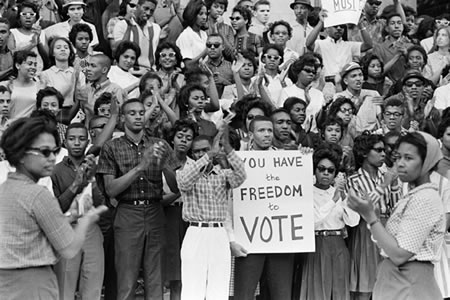
One of the most significant events in our country’s history was the civil rights movement of the 1960’s. From the March on Washington in 1963, where Dr. Martin Luther King delivered his inspirational “I Have a Dream” speech, to the march from Selma to Montgomery in 1965, the movement showed that people of all races and religions can come together to stand against injustice and oppression.
Over 50 years later, the fight against injustice and oppression continues. Today, a new generation of activists is faced with high incarceration and unemployment rates in the African American community, along with a growing divide between the rich and poor, a shrinking middle class, stagnant wages, high student debt, job and housing discrimination, and under-served communities that are struggling with increasing inequality, racial profiling and social unrest. From the Making Change at Walmart and the Fight for $15 campaigns to Black Lives Matter to the fight for LGBT equality to the fight to change our broken immigration system, activists have taken the lead in tackling these issues and pushed income inequality, social justice and gender equality into the national conversation.
Civil rights and labor leader A. Philip Randolph, who organized the March on Washington, once said that “A community is democratic only when the humblest and weakest person can enjoy the highest civil, economic, and social rights that the biggest and most powerful possess.”
The UFCW is proud to stand with today’s activists as they continue the fight for social and economic justice.
The post Black History Month: The Fight for Social and Economic Justice Continues appeared first on The United Food & Commercial Workers International Union.
]]>The post Women’s History Month: Celebrating the Lives of Addie Wyatt and Dolores Huerta appeared first on The United Food & Commercial Workers International Union.
]]>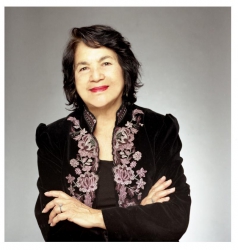
The third week of Women’s History Month gives us an opportunity to pay tribute to Addie Wyatt and Dolores Huerta, two extraordinary women who were shaped by the Great Depression, fought for workers’ rights during the height of the American Feminist Movement, and changed the face of organized labor.
Addie Loraine Cameron, better known as Addie L. Wyatt (1924 –2012), was born in Mississippi and moved to Chicago with her family in 1930. When she was 17 years old, she married Claude S. Wyatt, Jr.
She began working in the meatpacking industry in 1941. Although she applied for a job as a typist for Armour and Company, African American women were barred from holding clerical positions and she was sent to the canning department to pack stew in cans for the army. Due to a contract between Armour and the United Packinghouse Workers of America (UPWA), she earned more working on the packinghouse floor canning stew than she would have made working as a typist, and joined the UPWA after learning that the union did not discriminate against its members.
In 1953, she was elected vice president of UPWA Local 56. In 1954, she became the first woman president of the local, and was soon tapped to serve as an international representative. She held this position through the 1968 merger of UPWA and the Amalgamated Meat Cutters and Butcher Workmen until 1974, when she became director of the newly formed Women’s Affairs Department. In 1970s, she became the first female international vice president in the history of the Amalgamated Meat Cutters and Butcher Workmen and later served as director of its Human Rights and Women’s Affairs and Civil Rights Departments. She served as the first female African American international vice president of the UFCW after Amalgamated and the Retail Clerks International Union merged in 1979.
She and her husband were ordained ministers and founded the Vernon Park Church of God in Chicago. She played an integral role in the civil rights movement, and joined Dr. Martin Luther King, Jr. in major civil rights marches, including the March on Washington, the march from Selma to Montgomery, Alabama, and the demonstration in Chicago. She was one of the founders of the Coalition of Labor Union Women, the country’s only national organization for union women. She was also a founding member of the Coalition of Black Trade Unionists and the National Organization of Women.
In 1984, Addie Wyatt retired from the labor movement as one of its highest ranked and most prominent African American and female officials. In honor of her work, she was named one of Time magazine′s Women of the Year in 1975, and one of Ebony magazine′s 100 most influential black Americans from 1980 to 1984. The Coalition of Black Trade Unionists established the Addie L. Wyatt Award in 1987. She was inducted into the Department of Labor’s Hall of Honor in 2012.
Dolores Clara Fernandez, better known as Dolores Huerta, was born in 1930 in New Mexico, and grew up in the farming community of Stockton, California. She earned a teaching degree at Delta Community College. During that time, she met her first husband. She later married Ventura Huerta. In the early 1950s, she worked as an elementary school teacher, and many of her students were the children of farm workers who were living in poverty. Teaching the children of farm workers had a profound impact on her, and in 1955, she became one of the founders of the Stockton chapter of the Community Services Organization (CSO), which worked to improve social and economic conditions for farm workers and fight discrimination. Through her work at the CSO, she met Cesar Chavez.
In 1960, she helped create the Agricultural Worker’s Association (AWA), and in 1962, she and Chavez launched the National Farm Workers Association (NFWA), the predecessor to the United Farm Workers Union (UFW).
In 1965, she helped to organize the historic Delano Grape Strike and consumer boycott against growers of table grapes in California. The strike involved thousands of grape workers and was a significant victory for the UFW—leading to a first contract with these growers. In 1967, the NFWA combined with the AWA to create the United Farm Workers Organizing Committee. During this time, she negotiated contracts for workers, fought against the use of harmful pesticides, and advocated for unemployment and healthcare benefits for agricultural workers. In 1973, she led another successful consumer boycott against California grape growers that resulted in the California Agricultural Labor Relations Act of 1975, which allowed farm workers to form unions and bargain for better wages and working conditions.
Dolores Huerta stepped down from her position at the UFW in 1999, and established a foundation where she continues her work to improve the lives of workers, immigrants and women. She has received many honors for her activism, including the Presidential Medal of Freedom in 2012.
To learn more about Dolores Huerta, follow her on Twitter (@DoloresHuerta) or visit her foundation’s website at http://doloreshuerta.org/.
The post Women’s History Month: Celebrating the Lives of Addie Wyatt and Dolores Huerta appeared first on The United Food & Commercial Workers International Union.
]]>The post Black History Month: 50th Anniversary of the Immigration and Nationality Act appeared first on The United Food & Commercial Workers International Union.
]]>
Fifty years ago at the height of the civil rights movement, our country’s immigration policy was radically changed. The Immigration and Nationality Act, also known as the Hart-Celler Act, abolished the national origins quota system which favored some Europeans and excluded Asians and Africans and established a new immigration system that focused on attracting skilled labor to the United States and reuniting immigrants with their families.
The 1965 law, which opened the door to immigrants from Asia, Africa and Latin America and changed the demographic makeup of our country, was signed by President Johnson at the foot of the Statue of Liberty on October 3, 1965. An excerpt from President Johnson’s speech is as follows:
This bill says simply that from this day forth those wishing to immigrate to America shall be admitted on the basis of their skills and their close relationship to those already here.
This is a simple test, and it is a fair test. Those who can contribute most to this country–to its growth, to its strength, to its spirit–will be the first that are admitted to this land.
The fairness of this standard is so self-evident that we may well wonder that it has not always been applied. Yet the fact is that for over four decades the immigration policy of the United States has been twisted and has been distorted by the harsh injustice of the national origins quota system.
Under that system the ability of new immigrants to come to America depended upon the country of their birth. Only 3 countries were allowed to supply 70 percent of all the immigrants.
Families were kept apart because a husband or a wife or a child had been born in the wrong place.
Men of needed skill and talent were denied entrance because they came from southern or eastern Europe or from one of the developing continents.
This system violated the basic principle of American democracy–the principle that values and rewards each man on the basis of his merit as a man.
It has been un-American in the highest sense, because it has been untrue to the faith that brought thousands to these shores even before we were a country.
Today, with my signature, this system is abolished.
Today, the fight to create a fair and just immigration policy and make our country a more open place continues. It’s time to reform our country’s immigration system and create a clear and fair path to citizenship for aspiring Americans so that they can live and work without fear.
The post Black History Month: 50th Anniversary of the Immigration and Nationality Act appeared first on The United Food & Commercial Workers International Union.
]]>