The post Help Keep Our Members Safe in the Summer Heat appeared first on The United Food & Commercial Workers International Union.
]]>Soaring summer heat is approaching, which is a serious hazard for all our members; no matter where they work or what jobs they perform. With a lack of a federal OSHA heat standard, the UFCW’s Occupational Safety and Health (OSH) Office is advising locals to advocate for and protect all our members from the risk of heat illnesses this summer.
Why does heat safety matter? Every year, millions of workers in the United States are exposed to excessive heat while at work. Indoor and outdoor industries are at risk, including but not limited to construction, agriculture, food processing, iron and steel mills, and manufacturing.
In extremely hot conditions, the human body works hard to maintain a normal body temperature. But when the heat becomes too much for your system to handle, it can lead to the onset of heat-related illnesses such as heat cramps, heat exhaustion, and potentially fatal heat strokes.
What is a heat-related illness? A heat-related illness is an umbrella term used to describe negative symptoms or outcomes of occupational exposure to heat. It occurs when the body cannot efficiently cool itself. Workers who are exposed to prolonged heat without adequate hydration and cooling measures are at incredibly high risk.
Heat stroke occurs when the body can no longer regulate its temperature due to failing cooling mechanisms. This condition is extremely dangerous and can be fatal if you do not seek immediate medical attention. Key symptoms include a body temperature greater than 104 °F; hot, dry skin; an inability to sweat; altered mental status or confusion; slurred speech; and loss of consciousness. If someone begins showing signs of heat stroke, a quick response is critical and the following steps should be taken:
- Call 911 immediately.
- Move the worker to cool area and remove any unnecessary clothing.
- Cool the worker as quickly as possible (cold water/ ice bath, wet the skin, soak clothing with cool water, wet rag or towel around their neck).
- Stay with the worker until emergency medical personnel arrive.
Heat exhaustion occurs when the body starts to overheat but has not reached heat stroke status quite yet. Its onset may be gradual or sudden and can progress to heat stroke if not properly treated. Key symptoms include headache, nausea, dizziness, thirst, excessive sweating, and a body temperature between 101 and 104 °F. If a worker begins showing signs of heat stroke, follow these steps:
- Transport the worker to a clinic or emergency room for treatment. If medical care is not available, call 911 and stay with the worker until emergency medical personnel arrive.
- Move the worker to a cool area and remove unnecessary clothing to help cool their body temperature.
- Give the worker cool liquids to drink and encourage them to take frequent sips.
- Apply a cold compress to the head, neck and/or face to cool them down.
Heat cramps are brief, painful muscle spasms that happen when someone experiences electrolyte loss and dehydration. Symptoms include muscle spasms, or involuntary jerking movements accompanied with pain. If a worker begins experiencing heat cramps, the following steps should be taken:
- Give the worker water or a sports drink and a snack every 15 to 20 minutes to replace lost electrolytes and carbohydrates.
- If symptoms do not subside or become worse, call medical personnel. Workers who have chronic illnesses such as heart disease, diabetes, or asthma should also seek help from medical personnel, as their symptoms can be exacerbated.
Heat rash is the most common heat-related illness and presents as small red bumps or blisters. These blisters may appear in clusters on the chest, scalp, underneath breasts and in the groin area. Heat rashes can be addressed with the following steps:
- Transfer the worker to a cool, dry environment.
- Apply a rash powder to ease discomfort and keep the area dry.
- Avoid ointments and creams, as they can make the rash worse.
How can workers be protected from heat-related illnesses? Employers must ensure that all employees have equitable access to:
- Proper acclimatization methods
- Adequate amounts of cool or cold drinking water
- Cool/shady rest areas for relief
- Bathrooms with adequate bathroom breaks
- Functioning cooling systems and general ventilation systems
- A written protocol for responding to heat-related medical emergencies
- Proper education and training on heat-related illnesses and how to recognize a medical emergency
What is heat acclimatization? Heat acclimatization is the process of easing the body into a hot environment. It can be compared to easing into a hot bath. Initially, the sudden temperature change feels intense, but as you settle in, the body adapts, and the heat becomes tolerable. Proper heat acclimatization is done by gradually increasing heat exposure over a seven to 14-day period. This practice allows the body to stabilize blood circulation, release sweat more efficiently, and reduce cardiovascular strain while performing tasks. It is an important aspect of protecting workers from heat-related illnesses.
Here are what some states are doing about excessive occupational heat:
- California has a standard that requires employers to provide training, shade, water, and planning with a heat trigger of 80 °F.
- Colorado has a standard that protects agricultural workers from excessive heat.
- Maryland has a standard that protects both indoor and outdoor employees with exposure to a heat index at or above 80 °F.
- Minnesota has a standard that applies to indoor places of employment.
- Nevada has a standard that protects indoor and outdoor workers, as well as all private employers and all state and local government employees.
- Oregon has a comprehensive standard that applies to construction and forestry workers, as well.
- Washington has a standard for general industry, agricultural workers, and firefighters.
The post Help Keep Our Members Safe in the Summer Heat appeared first on The United Food & Commercial Workers International Union.
]]>The post Spotlight on: Hershey Chief Shop Steward appeared first on The United Food & Commercial Workers International Union.
]]>John Whitecavage is the Chief Shop Steward at his plant and has worked as a Sanitation Operator at the Hershey plant in Hazleton, PA for over 30 years.
As Chief Shop Steward, he oversees five to six stewards while working on grievances and other issues in the plant. In his role as Sanitation Operator, John does the hard work of keeping the plant clean, at times in confined spaces or under intense heat, to make sure the plant is still safe and clean for both consumers and his fellow workers.
His plant produces some of the most recognizable Hershey holiday products, the preparation for which kicks off at the beginning of summer. “You see Christmas stuff sitting around on the lines [over the summer]. It’s pretty neat.”
The work that John and his fellow plant workers do for the holiday season is critical, and when John sees people celebrating the holidays with Hershey candies he feels good “knowing that what we do every day is creating a safe product for the consumers.”
With 32 years of experience under his belt and a contract ratification this past March, John has one important message he wants to share: “There’s a lot of good workers at Hershey, a lot of good union members that work hard…making American made products…hopefully you know, they appreciate it.”
Making sure to shop union this Holiday season is more important than ever. With anti-union competitors taking up space on store shelves, John says he hopes “people realize” the importance of supporting union plants “and buy from us, not them.”
The post Spotlight on: Hershey Chief Shop Steward appeared first on The United Food & Commercial Workers International Union.
]]>The post From Albertsons & Smiths to Allegiant Stadium appeared first on The United Food & Commercial Workers International Union.
]]>Interview with Tom Strysniewicz, Super Bowl LVIII Ticket Raffle Winner
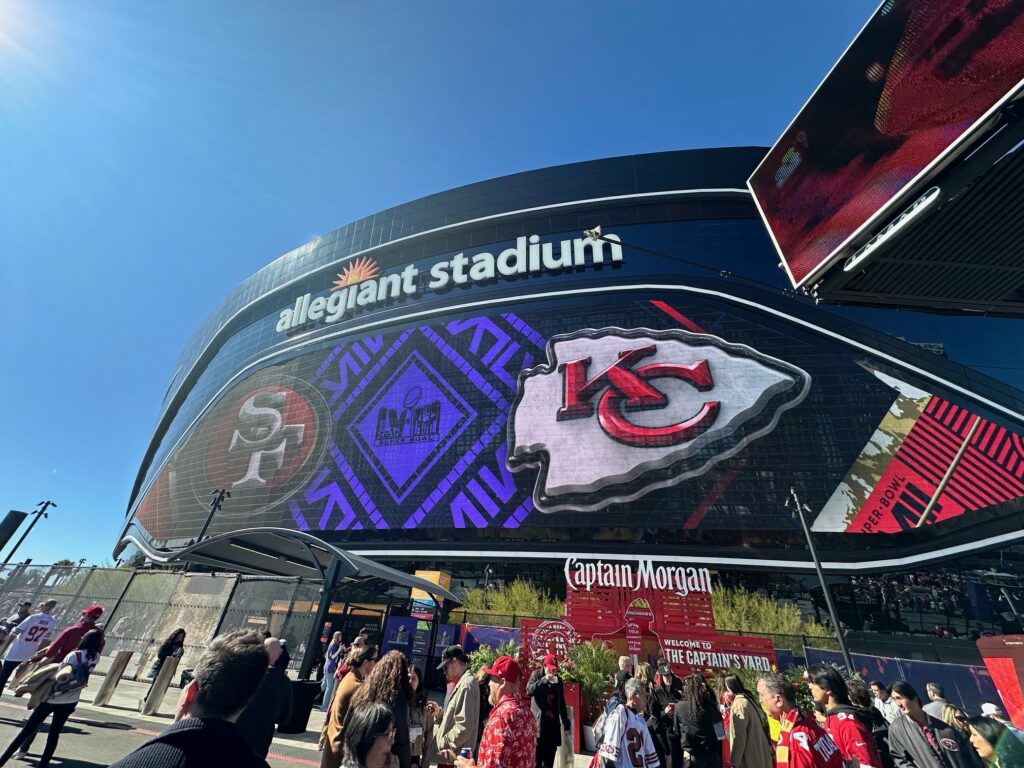
Every year, the NFL Players Association gives UFCW two Super Bowl tickets that we raffle off to our members as a token of our appreciation. In early February, Thomas (Tom) Strysniewicz, UFCW Local 711 worker, was informed that he was the winner. So this past Sunday, while the rest of us were watching the Kansas City Chiefs face off against the San Francisco 49ers from the comfort of a couch, Tom was watching the big game play out live from Allegiant Stadium at Super Bowl LVIII!

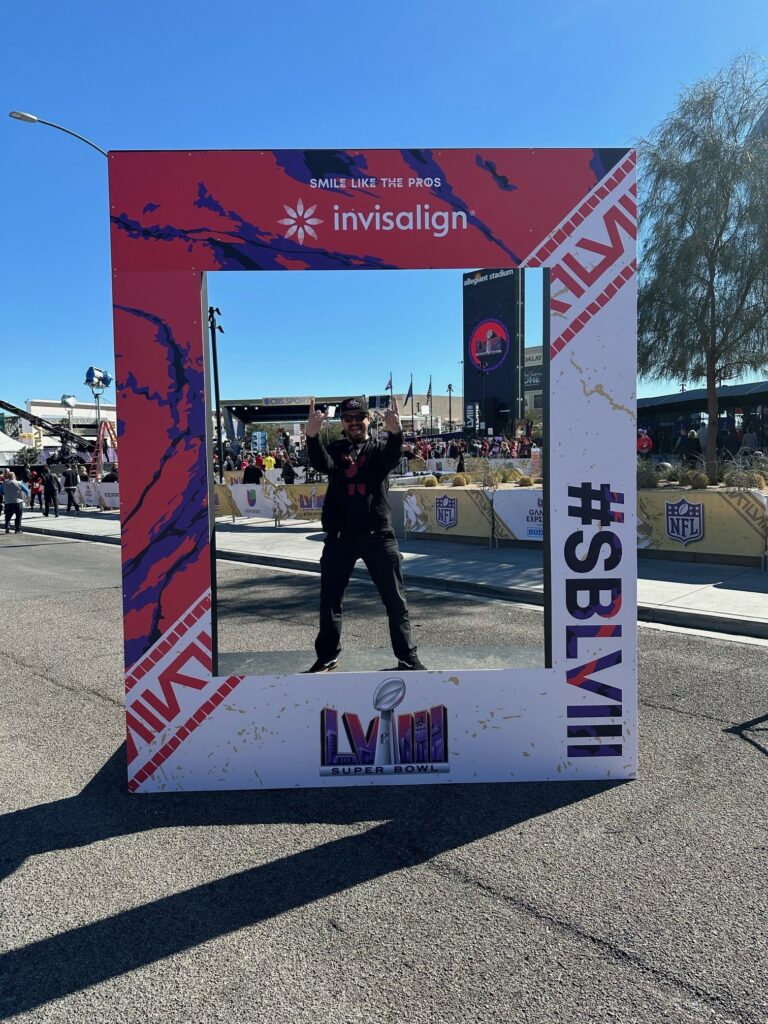
After the Chiefs defeated the 49ers in an overtime thriller and the confetti settled, we were able to catch up with Tom and are excited to share our interview about his experience, along with some photos with you all below.
UFCW: Tell us about yourself. Where do you work, and how long have you been a union member?
Tom: I started in the grocery industry back in 2015 here in Las Vegas, NV at Albertsons, where I was trained as a produce clerk. After a few years at Albertsons, I transferred over to Smiths store #346, where I currently reside. I am still in produce and tend the wet rack daily.
UFCW: How did you feel when you found out you were selected to attend the Super Bowl?
Tom: When I received a phone call two weeks ago from my local union office saying I was the winner, I was stunned. Deanne, from my Local informed me my name was chosen out of a hat to be the one to win two tickets to Super Bowl LVIII.
Shocked and in disbelief were probably the two feelings that ran through my mind during that call – immediately followed by insane screaming and jumping for joy!
UFCW: Who did you bring with you?
Tom: I ended up bringing my older brother John with me. He has been a member of our local union for the past 25 years and works in my store in the bakery. He was ecstatic when he found out I had won, and he was coming along with me to experience the game!
UFCW: How was your experience at the Super Bowl? Any surprises or highlights during the game?
Tom: Gameday was everything we could have hoped for and then some! We arrived supporting the San Francisco 49ers and started indulging in all the game day festivities. Lots of drinking, eating, and socializing with other game attendees followed. This was both my brothers and I’s first NFL game, so for it to be the Super Bowl on top of that made it that much more special! We were seated in the 49ers end zone along with a sea of San Francisco fans; we were right at home! The game was insane to say the least! We got to see many celebrities and athletes roaming around the stadium. The game even had a fan streak through the field during gameplay, which we all found hilarious!
The game was a nail-biter down to the last second in overtime. Even though the team we were rooting for lost, it was still a spectacular game that my brother and I won’t ever forget! We are both beyond grateful to have gotten the opportunity to experience such a spectacle!
UFCW: What was your favorite part of the halftime show?
Tom: The halftime performance with Usher was fantastic! Everything you would expect from a performance put on by a superstar and had all the glitz of a Las Vegas show in a 13-minute performance. He had us all on our feet, bobbing our heads to the music, and enjoying the atmosphere.
UFCW: Besides winning the Super Bowl tickets, what do you consider to be the most rewarding aspects of being a member of our union?
Tom: This wouldn’t have been possible had it not been for UFCW and the way it supports its members. That is what I would consider the most rewarding aspect of being in the union – having the support and backing of the UFCW and knowing that they are fighting daily on my behalf so that I can have a better chance at a great working environment and a better future for my family and I.
The post From Albertsons & Smiths to Allegiant Stadium appeared first on The United Food & Commercial Workers International Union.
]]>The post Protecting Our Workers From Cold Weather Hazards appeared first on The United Food & Commercial Workers International Union.
]]>The UFCW’s Occupational Safety and Health (OSH) Office has guidelines to help locals protect our workers from the risk of cold weather hazards this winter.
Cold stress begins to occur when our superficial body temperature begins to drop, eventually followed by our core temperature. As our body struggles to maintain its natural temperatures, various cold-related illnesses and injuries begin to rear their ugly heads, as follows:
Trench Foot
Trench foot is a foot injury that can be caused by long term exposure to both cold and wet conditions, as wet conditions cause feet to lose heat up to 25 times faster than dry heat. When one’s feet are constantly exposed to wet conditions, trench foot can become a threat to our members in as high as 60 degree Fahrenheit weather. Symptoms of trench foot include numbness, tingling, swelling, blisters, and bleeding of the feet. If you are experiencing these symptoms, it is important to receive medical assistance quickly and remove wet shoes and socks. After the removal of those clothing articles, dry the feet and keep them elevated to reduce tissue damage and swelling.
Frostbite
Frostbite is an injury caused by the freezing of skin tissue and develops into gray/white patches on the affected extremities, most commonly fingers, toes, noses, and earlobes. The main symptoms include color change, as well as tingling, aching, loss of feeling, and blisters in the affected areas. Frostbite is a severe condition and can lead to permanent nerve damage to the body and may necessitate amputation. If you believe that you are suffering from frostbite, getting into a warm room is your top priority. Protect the affected areas by wrapping them loosely in dry cloth. It is important that as you wait to receive medical attention, you DO NOT rub, massage, or try to rewarm the affected areas, as doing so may lead to more irreversible tissue damage.
Hypothermia
Under normal circumstances, our bodies maintain an internal body temperature of 98.6 degrees Fahrenheit, with a variation of less than one degree. When we experience prolonged exposure to temperatures that do not allow our bodies to heat itself faster, the body uses up its stored energy. Eventually the body’s core temperature dips under 95 degrees Fahrenheit, and at this point the victim begins to shiver uncontrollably, lose coordination, become confused, and drift in and out of consciousness. It is important to note that like trench foot, hypothermia can be impacted by wet conditions. With the presence of moisture, hypothermia can occur at temperatures over 40 degrees Fahrenheit. Once these symptoms are present, 911 should be called, and the victim should be moved to a warm room where their wet clothing is replaced with dry clothing and layers of blankets and vapor barriers. Warm drinks are helpful, as well as placing warm bottles or hot packs in armpits, sides of chests, and groins.
Chilblains
Chilblains are a painful inflammation of small blood vessels in the skin caused by repeated exposure to temperatures just above freezing to as high as 60 degrees Fahrenheit. Symptoms include redness, itching, blistering, inflammation, and in severe cases, ulceration. It is important to avoid scratching the affected areas and keep all blisters and ulcers clean and covered.
There are some straightforward ways to prevent these illnesses and injuries, and the following are just a few of the important things to keep in mind.
Wearing Proper Protection
It is crucial that we wear the appropriate attire to work every day, including shirts, pants, jackets, hats, shoes, and gloves. Our clothing choices should reflect our environment. If we are experiencing a constant change in temperature, layers should be worn. If we are experiencing extreme cold, insulated clothing should be worn, and if we are experiencing wet conditions, waterproof clothing should be worn. Wearing appropriate attire should not replace personal protective equipment (PPE); rather it should be used in addition to it.
Regular Breaks That Include Hydration
Most people believe that dehydration is only relevant when working in hot conditions, but this is not true. Your body utilizes hydration to regulate its internal temperature and decrease the risk of receiving a cold-related injury or illness. This, mixed with regular breaks that allow the body to recover from harsh environments, will allow a worker to not only survive the workday, but do so with comfort.
Outfit the Workplace
It is essential that when feasible, our workplace infrastructure includes heating systems and insulation, especially in break areas where workers must reset their internal and external body temperatures. Proper lighting is another important infrastructure factor that is overlooked during the winter months. When it is necessary to work outside under restricted daylight hours, lights are necessary to increase visibility and reduce the risk of accidents on the job.
Train the Workers
Empowering workers is a top priority when it comes to safety and health, and there is nothing more empowering than being trained about how to deal with the signs and symptoms of cold-related illnesses. These training sessions should cover early symptoms and warning signs, proper PPE and prevention strategies, and the importance of swift medical attention.
The post Protecting Our Workers From Cold Weather Hazards appeared first on The United Food & Commercial Workers International Union.
]]>The post Celebrate Valentine’s Day With Union-Made Products appeared first on The United Food & Commercial Workers International Union.
]]>Show some love this Valentine’s Day by buying products made by the hard-working members of the UFCW and our brothers and sisters at BCTGM.
Here’s a list of union-made products for Valentine’s Day:
Chocolate
See’s Candies
Russell Stover
Ghirardelli Chocolates
Hershey Kisses and Hugs
Necco Sweethearts
Tootsie Rolls
Sparkling Wine
Andre
Cook’s
J. Roget
JFJ
Tott’s
Wycliff
Floral Arrangements
Kroger
Meijer
Giant
Safeway
Ralphs
Vons
The post Celebrate Valentine’s Day With Union-Made Products appeared first on The United Food & Commercial Workers International Union.
]]>The post Black History Month 2024: The Art of The Strike appeared first on The United Food & Commercial Workers International Union.
]]>February is Black History Month and this year’s theme, “African Americans and the Arts”, highlights the artistic influence woven through the field of written, visual and performing arts, from both a historic and modern perspective.
In the labor movement, picket signs play a crucial role in messaging and mobilization – the creation of these signs and the act of striking is an artform within itself. Many signs made for and by Black workers have stood the test of time and visually mark some of the most historically recognizable picket lines.
Read on to view some examples of this artform and the history that accompanies it.
The Texas “Sick Chicken” Strike
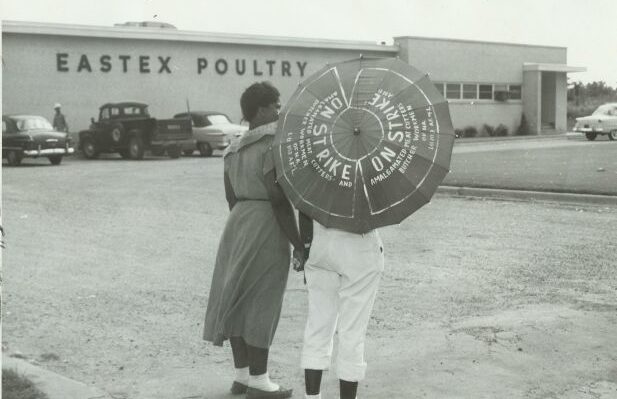
In 1953, Clara Holder, an employee at the Eastex Poultry plant in Center, Texas, wrote to the Amalgamated Meat Cutters (later evolving into the UFCW), seeking their assistance in unionizing her workplace. The majority of workers, predominantly Black women, faced unsanitary working conditions, unpaid mandatory overtime, and endured chronic health issues stemming from the demanding environment.
Faced with uncooperative plant management, the Amalgamated Meat Cutters initiated a national boycott of Eastex Poultry products. Simultaneously, in the spring of 1954, workers staged a collective walkout. This multipronged pressure campaign proved effective, compelling the company to return to the negotiating table after an 11-month strike. The resulting agreement included wage increases, paid holidays, and improved job security, marking a significant triumph for the workers (East Texas Historical Journal).
Two of these workers, pictured above, chose to utilize an umbrella bearing the message “On Strike,” to catch passerby’s eyes and protect theirs from the Texas sun.
United Packinghouse Workers Union Local 309
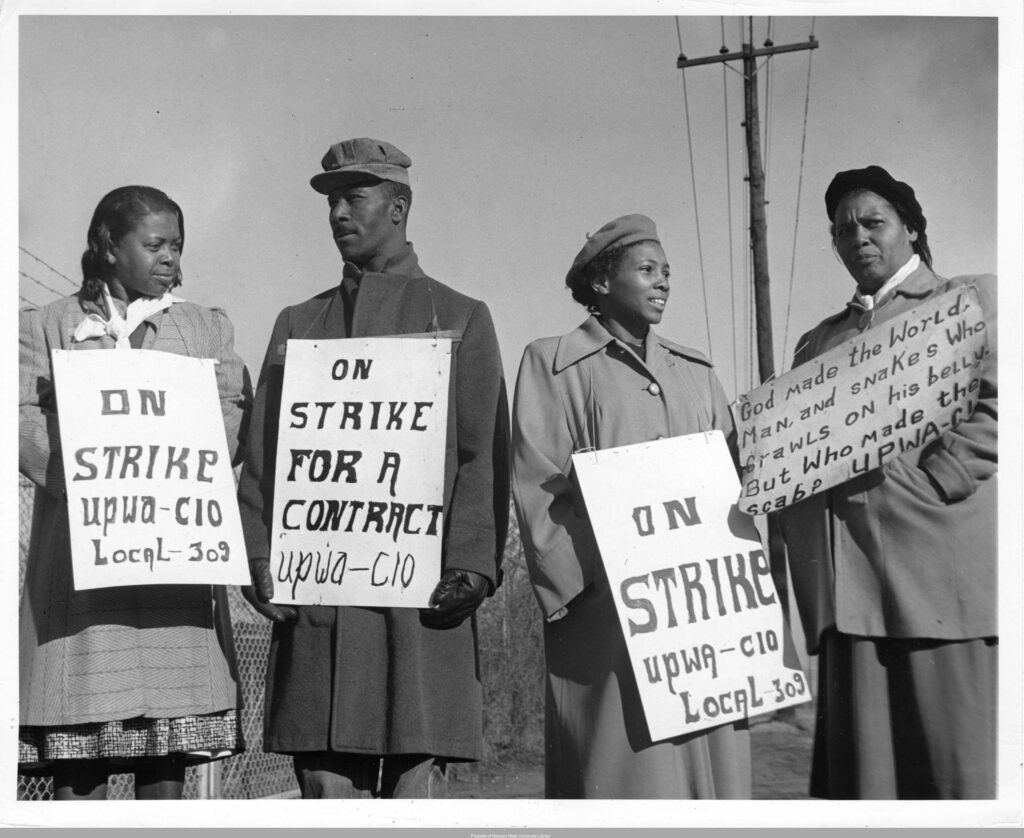
The image above shows four individuals from United Packinghouse Workers Union (which dissolved into the Amalgamated Meat Cutters and later joined the UFCW) Local 309, engaged in a strike against the W.W. Pickle Company (Wisconsin Historical Society).
Lucille Lewis, a woman among the strikers, displayed a picket sign conveying the outrage felt by the workers towards those who crossed their picket lines. Her sign carried the message: “God made the world, man, and snakes who crawl on his belly. But who made the Scab?”
The remaining strikers, from left to right, are Janie B. Harris, Arthur Germany, and Hattie Matthews.
Rose Hill Poultry Company Strike: Meatcutters Union, Local 525, 1962
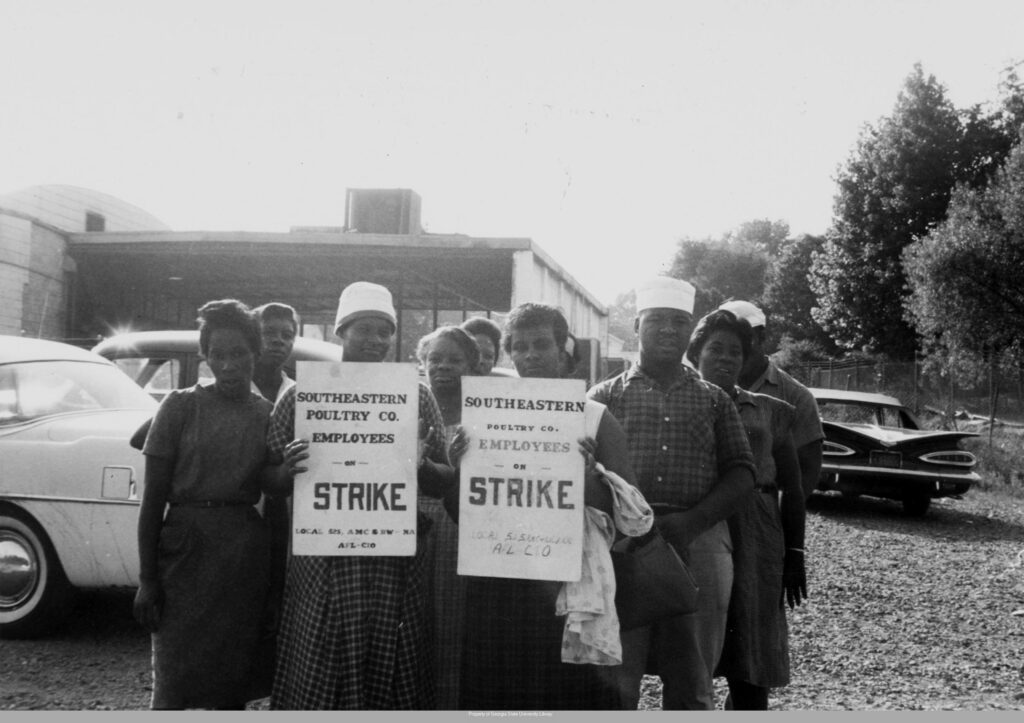
Throughout much of the 1960s, employees of Rose Hill Poultry, pictured above, fought for improved working conditions in the poultry industry. Engaging in a four-year-long picket line, they faced a bitter battle starting in 1962, which included a lawsuit, along with a prolonged, draining strike.
In the 1960s, the plight of these workers went largely unnoticed outside of Duplin County, N.C., except for support from civil rights groups and Local 525 of the Amalgamated Meat Cutters, which later became the UFCW.
Sadly, the Rose Hill poultry workers’ side of the story remained largely untold and it took another two decades for any investigation into working conditions in the state’s poultry industry to emerge (David Cecelski).
The post Black History Month 2024: The Art of The Strike appeared first on The United Food & Commercial Workers International Union.
]]>The post Have a Happy UFCW-Made Thanksgiving! appeared first on The United Food & Commercial Workers International Union.
]]>It’s time to celebrate the ultimate American holiday with food, side dishes, desserts and beverages produced by the hard-working members of our union family.
Here’s a list of UFCW-made products to enjoy this holiday season:
Turkey
Boar’s Head
Butterball 2
Foster Farms
Thumann’s
Hoffman’s
Honest John
Empire Kosher
Rogers Poultry
Palisades Ranch (meat & poultry
Ham
Appleton Farms
Berks Brand
Black Forest
Tyson
Butterball
Cook’s
Hormel Honey Rosted
Farmland Old-Fashioned Pit Ham
Father John
Cook’s Ham
Bacon
Father John
Sausage
Pontrelli & Laricchia
Stuffing
Manischewitz
Sides
Kraft Stove Top Stuffing
Hanover Foods Frozen Vegetables
Birds Eye Vegetables
Del Monte Canned Vegetables
Kraft Mac & Cheese
Ocean Spray Cranberry Sauce
Dole Cranberry Sauce
Mann’s Fresh Culinary Cuts Sweet Potatoes
Country Maid in Milwaukee Produces Deli Salads (macaroni salad, potato salad & spinach dip)
Healthy Choices
Overhill Farms
Baking
Pam Cooking Spray
Lucky Leaf Pie Filling
Wesson Corn, Sunflower, Canola, & Vegetable oil
Parkay
Blue Bonnett
Fleischmann’s Move Over Butter
Spreckels Sugar
Knouse Foods Cherry & Blueberry Pie Filling
Philadelphia Cream Cheese
Aunt Millie’s Bread Products
Dessert
Marie Callender’s
Kraft No Bake Cheesecake
Kroger Brand Pumpkin Puree
Food Club Canned Pumpkin
Reddi-Wip
Cool Whip
Beverages
Welch’s Non-Alcoholic Sparkling Wine
Nestle Hot Chocolate
Maxwell House Coffee
Silk Milk
Horizon Organic Milk
Delight Coffee Creamer
Melita
If your local would like to highlight holiday products made by your members, please send that information to Julie Anderson at janderson@ufcw.org.
The post Have a Happy UFCW-Made Thanksgiving! appeared first on The United Food & Commercial Workers International Union.
]]>The post Walmart Permanent Injunctions appeared first on The United Food & Commercial Workers International Union.
]]>Legal notice: Courts have enjoined non-Associate UFCW agents from entering Walmart property, except to shop, in AR, CO, FL, OH, TX, and MD and from doing non-shopping activity inside CA stores.
Read orders below.
The post Walmart Permanent Injunctions appeared first on The United Food & Commercial Workers International Union.
]]>The post Celebrate Halloween With Union-Made Candies appeared first on The United Food & Commercial Workers International Union.
]]>UFCW members, as well as our brothers and sisters at the Bakery, Confectionary, Tobacco Workers and Grain Millers International Union (BCTGM), have been hard at work to make sure there are plenty of union-made candies for all those trick-or-treaters.
Attached below is a list of union-made candies made by UFCW and BCTGM union members:
- Hershey’s Nuggets / Kisses
- Kit Kat
- Butterfinger*
- Baby Ruth*
- Smarties
- Jawbreakers
- Sour Patch Kids
- Tootsie Rolls
- York Peppermint Patties*
- Jolly Ranchers
- Bit-O-Honey
- Mary Jane Peanut Butter Chews
- Ghirardelli Chocolate Squares
- Jelly Belly Candy Corn
- Red Vines
*Some made in Mexico. Check packaging for country or origin.
The post Celebrate Halloween With Union-Made Candies appeared first on The United Food & Commercial Workers International Union.
]]>The post UFCW Celebrates Hispanic Heritage Month appeared first on The United Food & Commercial Workers International Union.
]]>Friday, Sept. 15 marks the beginning of Hispanic Heritage Month—a time for the UFCW to pay tribute to Hispanic Americans and their positive contributions to our union, communities and country. It provides an opportunity to celebrate the histories, cultures and contributions of American citizens whose ancestors came from Spain, Mexico, the Caribbean and Central and South America. The 2023 National Hispanic Heritage Month theme, “Latinos: Driving Prosperity, Power, and Progress in America,” highlights the contributions of Hispanic Americans to America’s economic, political, and social growth.
The origins of this celebration date back to President Lyndon Johnson, who first established Hispanic Heritage Week in 1968. In 1988, President Ronald Reagan expanded the celebration to cover a 30-day period from Sept. 15 to Oct. 15. Hispanic Heritage Month was enacted into law in 1988, and the start date of Sept. 15 was chosen for the celebration because it marks the anniversary of independence for a number of Latin American countries.
Hispanic heritage holds an indelible place in the heart and soul of our nation, and Hispanic Heritage Month reminds us that the American identity is a fabric of diverse traditions and stories woven together. Since the beginning, our country has drawn strength and insights from Hispanic writers, scientists, soldiers, doctors, entrepreneurs, academics, and leaders in labor and government.
Observing Hispanic Heritage Month allows the UFCW to recognize and support the work Hispanic Americans are doing to service our workers and help our union grow. Throughout Hispanic Heritage Month, the UFCW would like to pay tribute to the culture and history of Hispanic Americans and their positive impact on the labor movement. If you have members who would like to share their stories about what this month means to them, please reach out to Julie Anderson at janderson@ufcw.org.
The post UFCW Celebrates Hispanic Heritage Month appeared first on The United Food & Commercial Workers International Union.
]]>